About Eupithecia subumbrata (Denis & Schiffermüller), 1775
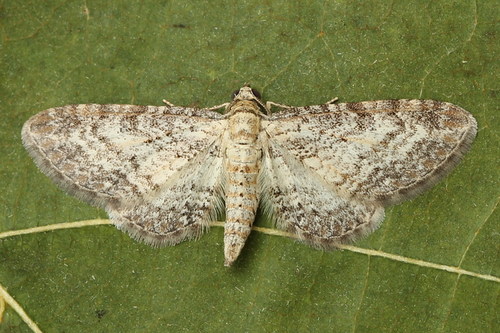
Eupithecia subumbrata, commonly called the shaded pug, is a moth in the family Geometridae. The species was first formally described by Michael Denis and Ignaz Schiffermüller in 1775. Its distribution ranges from Mongolia and the Altai Mountains through Siberia, central Asia, Asia Minor and Russia to western Europe, and extends from central Scandinavia down to the Mediterranean region. The wingspan of this moth measures 18 to 21 mm. The forewing has a pale greyish-brown or white ground color, with an oval dark spot in the center and pale or darker greyish-brown transverse bands, though these markings are usually indistinct. The hindwing is dirty white, and is brown along its outer edge. This species does not have any noticeable distinguishing features visible in the field, and examination of its genitals is required for certain identification. The larvae are long and thin, and can be either light brown or green, with scattered small white warts across their bodies. This species produces one generation per year, with adults active in flight from the start of May through August. The larvae are polyphagous, feeding on a variety of different plants, including Galium mollugo, Hypericum perforatum, and species in the genera Pimpinella, Senecio and Solidago. Larvae can be found from July to September, and the species overwinters in its pupal stage.