About Eupithecia subfuscata (Haworth, 1809)
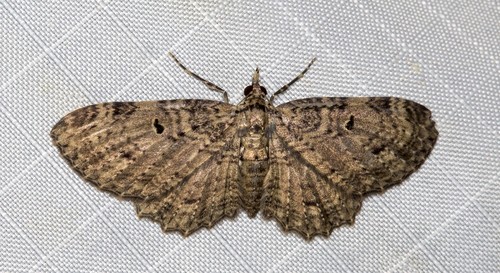
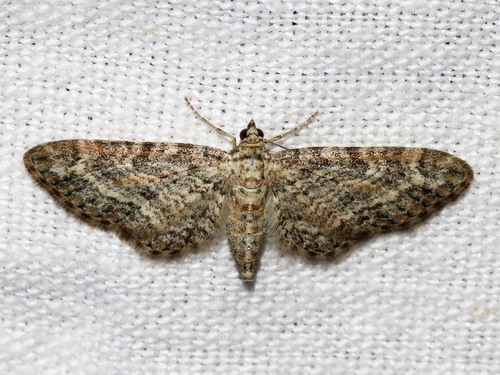
This species, Eupithecia subfuscata, has forewings that are grey, sometimes with an ochreous tinge, marked with pale fascia and radial lines that create a mottled appearance. It also has a pale sub-marginal line and a small discal spot on the forewings. The hindwings are much paler and plainer, and also have a small black discal spot. Melanism is quite common in this moth, and its wingspan measures 17–21 mm. Final instar larvae are smooth and elongated. They are colored grey-green or red-brown, and have a grey-green to dark olive-green diamond-like pattern on the back, with whitish side edges. The pupa is yellow-brown with greenish wing sheaths, and it has six hook bristles at the cremaster; the middle pair of these bristles is more powerfully formed. The larvae feed on the leaves and flowers of a wide variety of plants, including Abies (fir), Achillea, Aegopodium (ground-elder), Alnus (alder), Angelica, Artemisia, Betula (birch), Centaurea, Cirsium (creeping thistle), Comptonia (sweetfern), Epilobium (willowherb), Filipendula (meadowsweet), Galium (bedstraw), Hypericum (St John's wort), Larix (larch), Lysimachia (yellow loosestrife), Malus (apple), Ononis (restharrow), Picea (black spruce), Populus (poplar), Rubus (raspberry), Salix (willow), Scabiosa, Solidago (goldenrod), Tanacetum (tansy), Urtica (nettle), and Valeriana (valerian).