About Eupithecia exiguata (Hübner)
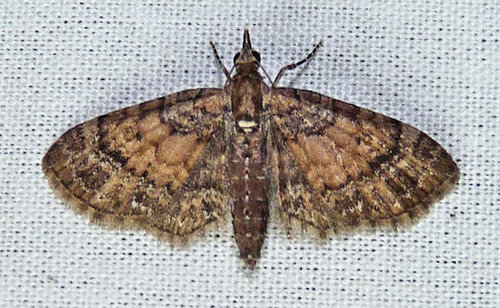
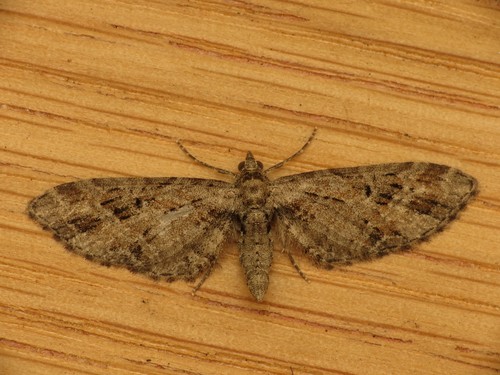
The mottled pug, with the scientific name Eupithecia exiguata (Hübner), is a moth that belongs to the family Geometridae. Jacob Hübner first formally described this species in 1813. It can be found throughout the Palearctic region, except in areas surrounding the Mediterranean Sea. It is common across most of the British Isles, but it only occurs locally in Scotland. The moth has a wingspan of 20–22 mm. Its forewings are long and pointed, and are colored brown or yellowish grey. They are marked with pale radial lines and a large, somewhat oval black discal spot. The most distinctive markings of this species are strong black dashes that sit on the radial and median veins where these veins cross the postmedian band. The hindwings are cream or grey, and also feature a discal spot. The larva is green, and has lozenge-shaped red spots along its back. Adult moths of this species fly at night during May and June. They are attracted to light, and sometimes arrive in large numbers. The larvae feed on the foliage of a range of different trees and shrubs. This species overwinters in the pupal stage. The recorded food plants of Eupithecia exiguata are: Acer (sycamore), Berberis, Crataegus (hawthorn), Lonicera (honeysuckle), Malus (apple), Prunus, Ribes (redcurrant), and Sorbus (rowan).