About Euphyes dukesi (Lindsey, 1923)
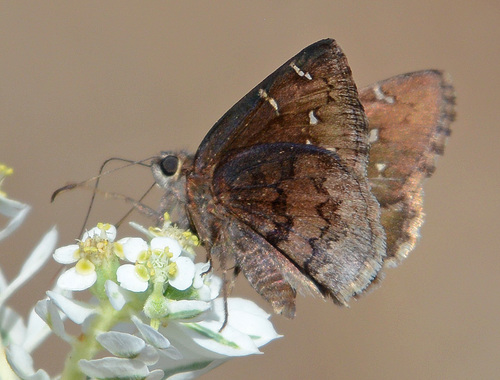
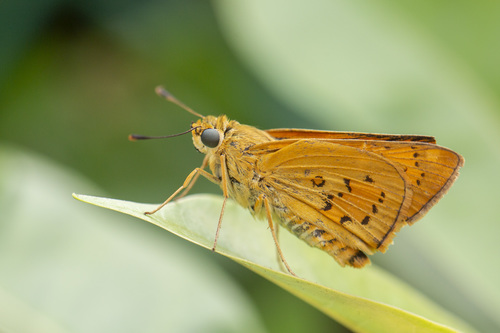
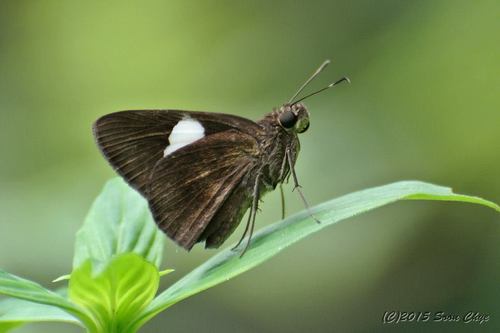
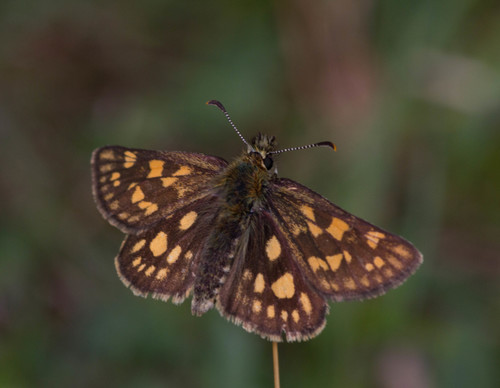
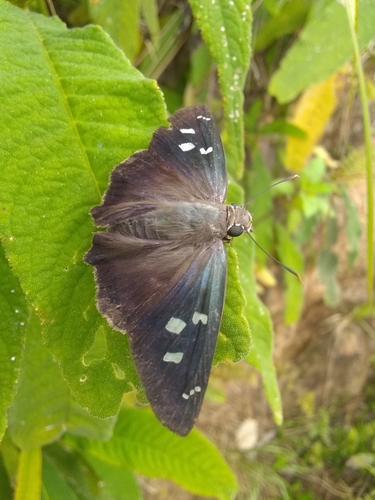
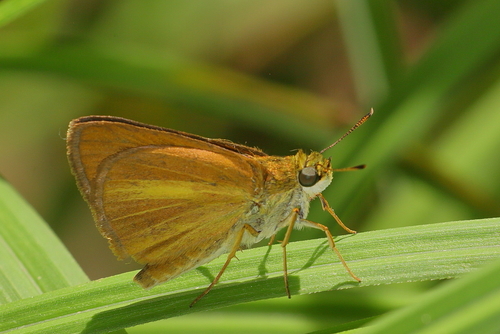
Euphyes dukesi, commonly called Duke's skipper, has short, rounded wings with a wingspan ranging from 32 to 38 mm (1.3 to 1.5 in). The upper surfaces of the wings of both sexes are deep brown. The underside of the hindwings is light brown, marked with pale yellow rays. While similar in appearance to other species in the genus Euphyes, the single yellowish streak on the underside of the hindwing is an unmistakable identifying feature. Females are slightly larger than males. Females have a hindwing band that holds two to three pale yellow spots, while males have a black stigma on the forewing. Caterpillars of this species have a light green body and a black head. For males, the genitalia have five toothed processes at the end of the aedoeagus. Duke's skipper occurs in scattered locations across the eastern United States and a small section of southeastern Canada. It has three distinct geographically clustered populations: one along the Atlantic Coast from southeastern Virginia to northern peninsular Florida; one in the lower Mississippi Valley from central Missouri and southern Illinois south to the Gulf Coast; and one in extreme southwestern Ontario, southeastern Michigan, northeastern Indiana, and northern Ohio. Its confirmed distribution includes the Canadian province of Ontario, plus the following U.S. states: Alaska, Arkansas, Florida, Georgia, Illinois, Indiana, Kentucky, Louisiana, Michigan, Missouri, Mississippi, North Carolina, Ohio, South Carolina, Texas, and Virginia. The split distribution between coastal plains and the Great Lakes area is unusual for North American butterflies. It has been hypothesized that this pattern comes from population displacement during Pleistocene glacial intervals, followed by dispersal through the vegetative corridors of the Mississippi and Mohawk valleys after ice sheets retreated. Females lay eggs singly underneath the leaves of host plants that larvae feed on. Larvae molt several times, then enter diapause to overwinter during their fourth instar. In spring, they feed again, molt one additional time, then pupate for approximately two weeks before emerging as adults. The adult lifespan is estimated at three weeks, and the total lifespan from hatching is about one year or less. Larval host plants are restricted to various sedges in the genera Carex and Rhynchospora. These include hairy sedge (Carex lacustris) found in northern shaded wetlands such as coastal swamps and ditches; shoreline sedge (Carex hyalinolepis) found in the southern Mississippi River basin; false hop sedge (Carex lupuliformis); Carex walteriana; Walter's sedge (Carex striata) found in the southeast; narrowfruit horned beaksedge (Rhynchospora inundata); and millet beaksedge (Rhynchospora miliacea) found in Florida. Adult Duke's skippers feed on flower nectar from a variety of plants, including buttonbush (Cephalanthus occidentalis), common milkweed (Asclepias syriaca), swamp milkweed (Asclepias incarnata), spotted Joe-Pye weed (Eupatorium maculatum), blue mistflower (Eupatorium coelestinum), pickerelweed (Pontederia cordata), hibiscus species (Hibiscus), common sneezeweed (Helenium autumnale), alfalfa (Medicago sativa), and red clover (Trifolium pratense).