About Euphyes arpa (Boisduval & Le Conte, 1829)
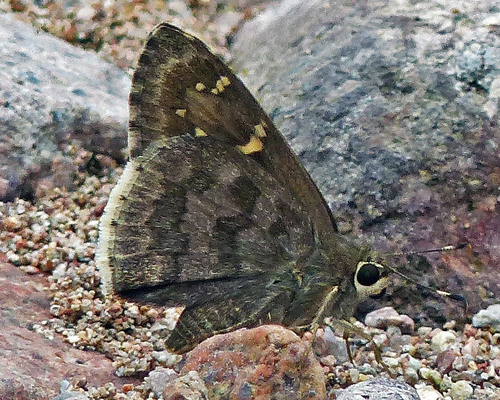
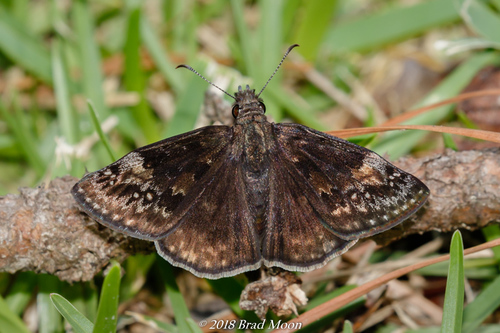
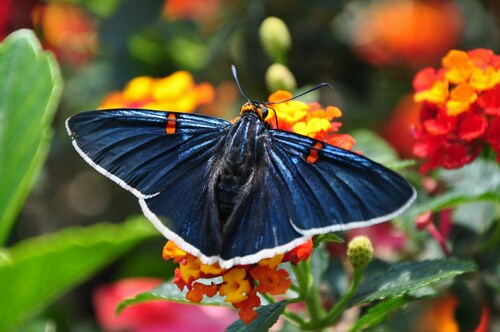
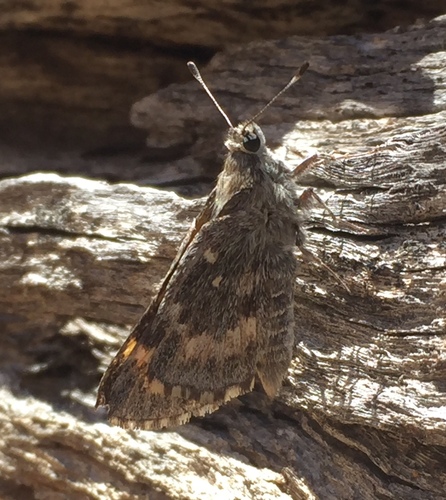
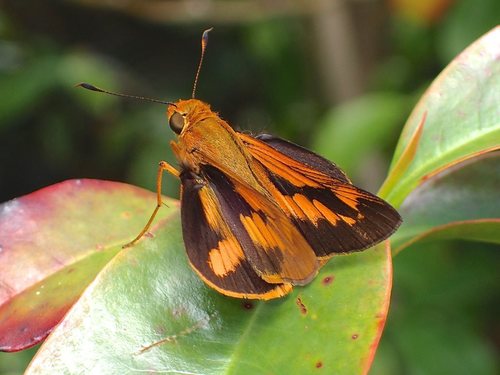
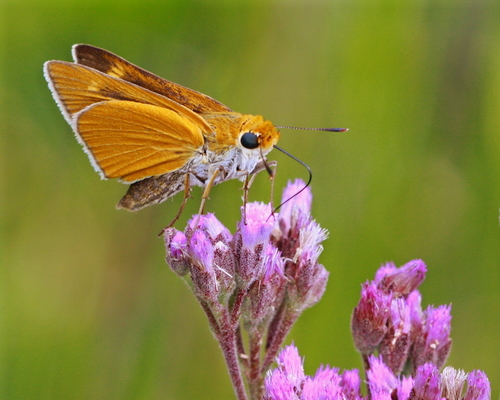
Euphyes arpa, commonly nicknamed the Palmetto Lowcountry Skipper, is a species of skipper butterfly first described by Boisduval & Le Conte in 1829. This is a relatively large butterfly, easy to spot, with a wingspan of 41–49 mm (1 3/4 to 2 inches). Both sexes have orange heads, an orange underside, bright orange thoraxes, and yellow-orange undersides to their hindwings. Male and female individuals differ in their upper forewing coloration: males are more colorful, with a bright reddish-yellow forewing marked by black borders and a black hindwing. Males also have a distinctive two-part black stigma, a sex mark containing scent cells that release pheromones to attract mates. Females have more neutral dark coloring, with a black upper forewing that only holds a small number of reddish-yellow patches. This butterfly is distributed along the southeast coast of the United States. It is most commonly found in Florida, and has also been documented in adjacent Georgia, Alabama, and Mississippi; it may only be established as a permanent resident in Florida and Mississippi. Despite its common name referencing South Carolina (the Palmetto State) lowcountry, the species has never been recorded in South Carolina's lowcountry or surrounding regions. Its habitat is generally moist areas with low palmetto scrub that has an abundant growth of saw palmetto, including open pine flats and forested scrub/shrub wetlands. The larvae feed on the fronds of saw palmetto (Serenoa repens), and live in silken tubes at the base of the fronds. This species overwinters in the larval stage. Adult Palmetto Lowcountry Skippers are nectivores that feed on flower nectar from a range of plants, including pickerelweeds of the genus Pontederia, and are often found near flowers. When seeking mates, adult males perch on palmetto scrub blades or wait in sedge marshes for receptive females. While males wait for mates, females deposit eggs near the base of palmetto scrub blades, close to the plant's stem. Euphyes arpa is classified as endangered. Its population decline remains relatively unexplained, as the species has a readily available food source in its range.