About Euphydryas phaeton (Drury, 1767)
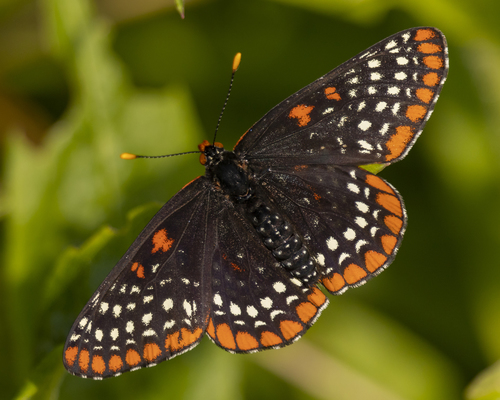
The Baltimore checkerspot, scientifically known as Euphydryas phaeton, is a North American butterfly that belongs to the family Nymphalidae. It has been the official state insect of the U.S. state of Maryland since 1973. This butterfly was named after the first Lord Baltimore, because its coloration matches the colors on his family crest. Even though it holds the status of Maryland’s state insect, its local population in Maryland has declined significantly, and it is currently listed on the "rare, threatened, and endangered" animal list maintained by the Maryland Department of Natural Resources.
During the Baltimore checkerspot’s growth period, it seeks out a host plant to get nourishment. Its native larval host plant is white turtle head, Chelone glabra. To some degree, the species has also started using the introduced lawn weed English plantain, Plantago lanceolata, and other plants as host sources. Most butterflies and moths overwinter in the form of eggs, pupae, or occasionally adults; the Baltimore checkerspot is different, and overwinters as larvae instead. In late summer, between July and September with timing varying based on latitude, weather, and other factors, larvae spin a pre-hibernation web on a plant, stop feeding, and stay inside this web. Several months later, they leave the web and move into ground litter made of dead grass, leaves, and similar material, where they spend the winter.