About Euphydryas maturna (Linnaeus, 1758)
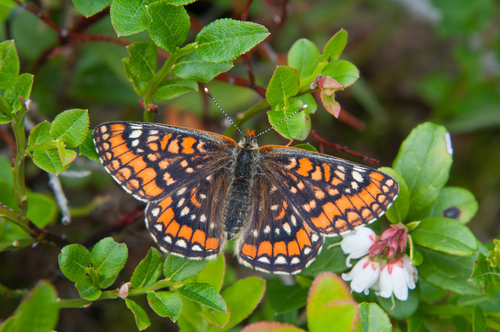
Euphydryas maturna, commonly known as the scarce fritillary, has a wingspan between 35 and 42 mm. The upper side of its wings has a black-brown base color, patterned with orange bands and a distinct set of white spots. The veins and wing margins are black and brown. The underside of the wings is orange with blurred fine details. Underside forewings show a wide range of light and dark orange shades, while underside hindwings are orange with white spots bordered in black. The pattern on the underside of the forewings is particularly washed out. Fully grown caterpillars reach up to 30 mm in length. They are dark-colored with prominent bright yellow spots, and are covered in numerous dark tubercles and hairs along their body. Pupae are typically white with dark spots and yellow warts on the abdomen. In Seitz’s description, this species (listed as M. maturna L. (= cynthia Esp., mysia Hbn.) (65a)) is classified as one of the larger species in its group. The basal and outer areas of the wings are bright red-brown, and the disc is marked with white spots. The underside is orange-red with black markings; the forewing has yellow spots in the cell, beyond the cross-veins, and before the distal margin. The underside of the hindwing has three rows of spots: one near the base, with a lunule in the cell standing slightly separate, a median band divided by a black line, and a row of marginal lunules edged proximally by black arcs. In the Ural region, the subspecies uralensis Stgr. (65a) occurs, replacing E. m. staudingeri Wnukowsky, 1929. In this subspecies, the yellowish white spots on the wing upperside are more prominent, approaching the appearance of Euphydryas iduna (Dalman, 1816), which may be considered the arctic form of maturna. The scarce fritillary inhabits moist, open terrain overgrown with ash trees and ash bushes. Its population has declined rapidly across Central Europe, and it is no longer found in some areas. During the life cycle, females lay their distinctive red eggs on the undersides of ash leaves, most often choosing seedlings approximately 2 meters (6.5 feet) high. The full clutch is laid in a layered cluster with a diameter of only 1 cm (0.39 inch). Selecting a suitable oviposition site is critical, as temperature, humidity, and light conditions must meet exact requirements. Because of this, when population numbers are high in a given year, multiple females may lay eggs on the same leaf. After hatching, young caterpillars weave a shared web over the entire leaf and all live together within it. They only eat specific parts of leaves, leaving behind a characteristic damage pattern of curled leaves and their webs that makes this species easy to identify. Starting from the end of June, when caterpillars have grown to approximately 1 cm (0.39 inch) long, they leave their host plant by dropping to the ground, or falling off with dry leaves. Small groups then hide in leaf litter to overwinter. The following spring, they become solitary and expand their diet to include other plant species. It has been hypothesized that the restricted ash-only diet of the early life stage occurs because scarce fritillary eggs are only laid on ash tree leaves; after this stage, caterpillars have a broad diet that includes many different plants. Fully grown caterpillars pupate in May; this timing gives the species its German name "Maivogel", literally meaning "May bird".