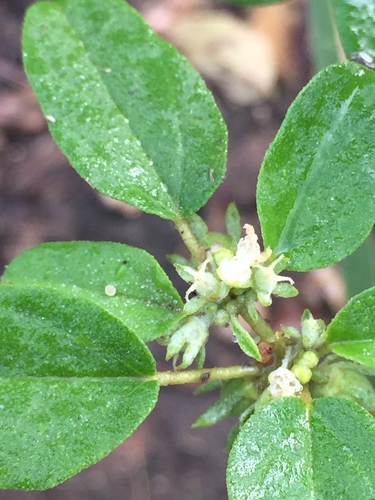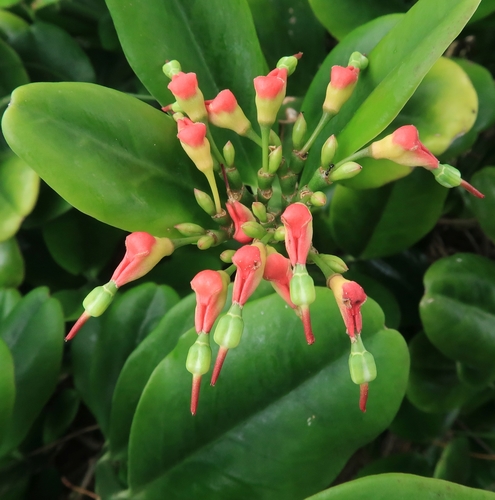
About Euphorbia tithymaloides L.
Euphorbia tithymaloides L. is a shrub that grows to 1.8 to 2.4 metres (6 to 8 ft) in height and generally reaches 45 to 60 cm (18 to 24 in) in width. Its leaves are simple angiosperm leaves arranged oppositely on the stem. Each leaf is sessile, attaching directly to the plant, and measures 35 to 75 mm (1.4 to 3 in) in length. Leaves are glabrous (smooth), acuminate in shape, have entire smooth edges, and feature pinnate venation. All roots, stems, and leaves of this plant are toxic. These plant parts contain euphorbol, a complex terpene, and other diterpene esters, which are known carcinogens. Leaves and stems also contain beta-sitosterol, cycloartenone, octacosanol, and oxime, all of which have both documented medicinal and toxic properties. Even just a few drops of juice from Euphorbia tithymaloides root can irritate mucosal membranes. When ingested, irritation to the mucosal membranes of the stomach and intestines causes nausea and vomiting. Topical exposure to the juice causes skin irritation, inflammation, and even blisters. If the juice gets into the eye, it causes severe pain, keratoconjunctivitis, and reduced visual acuity. Ingesting only a few seeds can lead to violent, persistent vomiting and extreme diarrhea. If latex or root juice contacts the skin, the affected area should be washed immediately with soap and warm water. If latex or juice gets in the eye, continuous rinsing with fresh water is the recommended first step. Topical steroids are prescribed for skin or eye exposure. Intravenous fluids are often given to replace fluid loss caused by vomiting and diarrhea. Euphorbia tithymaloides was introduced as a garden plant before 1688; the first recorded garden cultivation of the species was in Amsterdam. It is primarily grown as an outdoor garden border plant, though certain varieties grow well indoors. Due to its toxicity, gardeners are advised to wear goggles, gloves, long-sleeved shirts, and long pants when working with this plant. It can be propagated from either seed or cuttings. Cuttings must be taken above a joint, be 13 to 15 cm (5 to 6 inches) long, planted in sandy, nutrient-rich soil, and allowed to root before being moved to a permanent planting location. Cuttings are taken in March–April or June–July, from the middle or top of the main stem. Hummingbirds are attracted to the plant's flowers, while cabbage worms feed particularly readily on its leaves. This species prefers sandy, well-drained, nutrient-rich soil with higher concentrations of boron, copper, iron, manganese, molybdenum, and zinc. It is generally intolerant of high soil salinity, but can tolerate saline conditions if properly fertilized. Well-watered plants tend to grow taller and produce more biomass. It requires full sun to grow well. Municipalities plant Euphorbia tithymaloides in landfills, toxic waste sites, and along roadsides, because it is one of the few species that can thrive in these challenging environments. Medicinally, the root of Euphorbia tithymaloides is known to be a powerful emetic. A proteolytic enzyme called pedilanthain can be extracted from the plant's latex; experiments have shown it is effective against intestinal worms and reduces inflammation when ingested. In 1995, a galactose-specific lectin was purified from the plant's latex, and research suggests it may be useful for treating diabetes mellitus. In folk medicine, leaf tea has been brewed to treat asthma, persistent coughing, laryngitis, mouth ulcers, and venereal disease. Root tea has been used as an abortifacient. Latex has been applied topically to treat calluses, ear ache, insect stings, ringworm, skin cancer, toothache, umbilical hernias, and warts. None of these folk medicine uses have been scientifically verified as effective. In the West Indies, a few drops of the latex is added to milk and used as an emetic. In Peru, this plant is called "cimora misha", "timora misha", or "planta magica", and is sometimes added to drinks made from mescaline-containing Trichocereus cacti, although Euphorbia tithymaloides has no known psychoactive properties. In Bengal, India, the species is known as "rang chita". Its fast growth rate and ability to grow in relatively toxic soils have led Indian scientists to investigate its potential use as a "petrocrop", a plant that can produce biofuel compounds for internal combustion engines.