About Euphorbia tirucalli L.
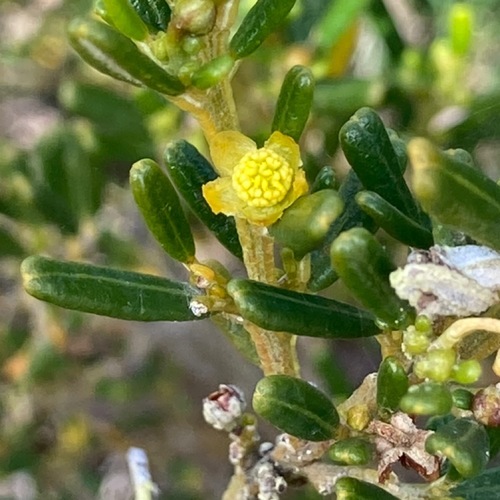
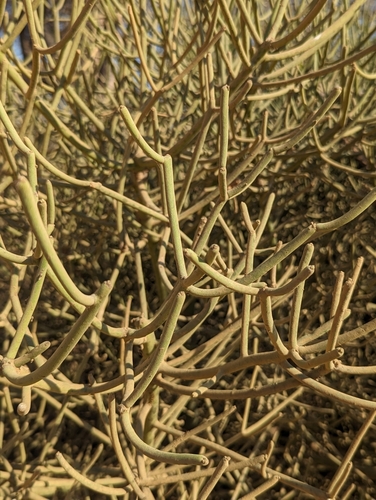
Euphorbia tirucalli L., commonly called the pencil tree, is a shrub or small tree that reaches a maximum height of 7 metres (23 ft). It has cylindrical, fleshy stems, with fragile succulent twigs that are 7 millimetres (0.28 in) thick. The twigs are often arranged in whorls, and have fine longitudinal striations. Its branches are green, smooth, succulent, and roughly pencil-thick. Its oval leaves measure 1 to 2.5 centimetres (0.39 to 0.98 in) long and around 3 to 4 millimetres (0.12 to 0.16 in) wide, and typically drop off early. The plant produces a milky sap that is toxic and corrosive. Its yellow flowers grow at the tips of branches.
This species has a wide distribution across Africa, growing in black clay soils, and is most prominent in northeastern, central, and southern Africa. It may also be native to other regions of the African continent, nearby surrounding islands, and the Arabian Peninsula. It has been introduced to many other tropical regions, including Brazil, India, Vietnam, the Philippines, and Ghana. It grows in dry habitats, especially savanna. It is commonly used as cattle feed or as living hedging. In Sri Lanka it is well-known; it is called kaḷḷi (கள்ளி) in Tamil, a name that appears in the Akanaṉūṟu by Sri Lankan Tamil poet Eelattu Poothanthevanar, and is called weradi nawahandi (වැරදි නවහන්දි) or gas nawahandi (ගස් නවහන්දි) in Sinhalese.
Many cultures use Euphorbia tirucalli as a form of alternative medicine. In countries including Brazil, India, Indonesia, and Malaysia, people have attempted to use it to treat cancer, excrescences, tumors, warts, asthma, cough, earache, neuralgia, rheumatism, and toothaches. While Euphorbia tirucalli has been promoted as an anticancer agent, research shows it suppresses the immune system, promotes tumor growth, and causes the development of certain types of cancer. It has also been linked to Burkitt's lymphoma, and is thought to act as a cofactor for the disease rather than a treatment for it.
The latex of Euphorbia tirucalli can be used as fuel. This application led chemist Melvin Calvin to propose commercial exploitation of E. tirucalli for oil production. This use is especially attractive because E. tirucalli can grow on land that is not suitable for most other crops. Calvin estimated it could produce 10 to 50 barrels of oil per acre. In the 1980s, Brazilian national petroleum company Petrobras started experiments based on these ideas. E. tirucalli has also been used to produce rubber. Neither the oil nor rubber production from this species has been very successful to date.