About Euphorbia telephioides Chapm.
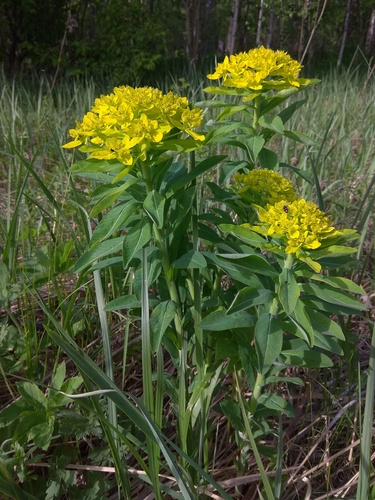
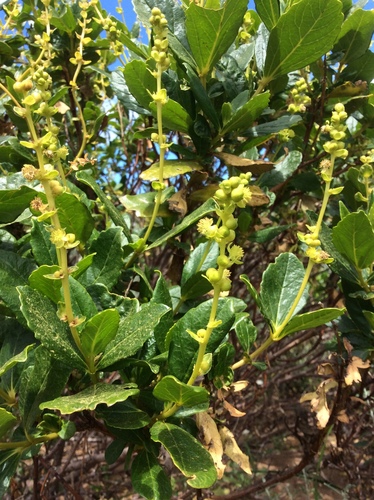
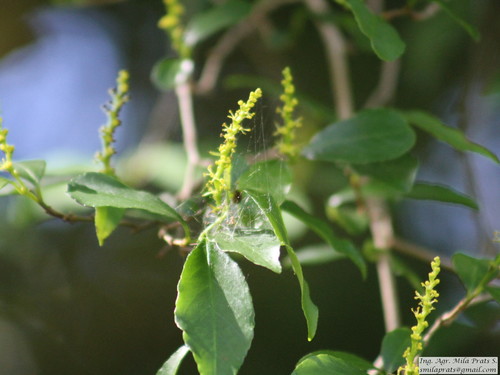
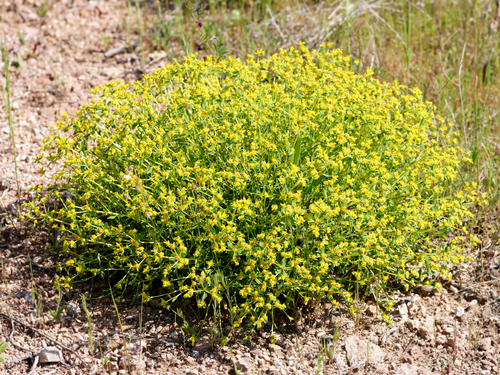
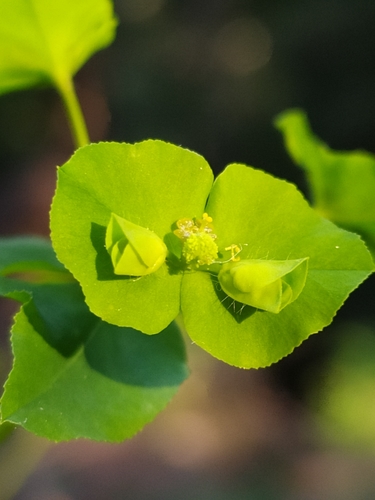
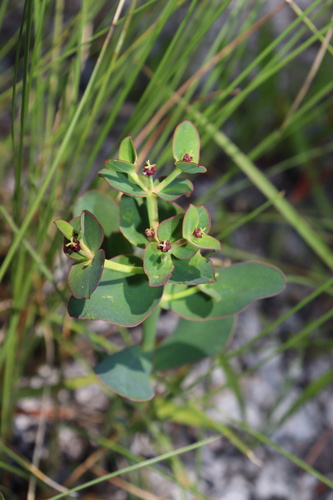
Euphorbia telephioides Chapm. is a rare euphorb species commonly called Telephus spurge. It is endemic to Florida in the United States, and only found in three Panhandle counties: Bay, Gulf, and Franklin, where it grows in coastal areas. It is a federally listed threatened species in the United States. There are approximately 38 known extant populations of this species; some populations have been newly discovered, while others have been extirpated recently. It grows in scrub and forest habitat, often alongside slash pine (Pinus elliottii), longleaf pine (Pinus palustris), or oaks. Much of its habitat is flatwoods, with sandy soil. While the plant can be common or even abundant at many of its known locations, it is short-lived and can disappear from an area very quickly. This is a perennial herb that reaches a maximum height of 30 to 40 centimeters. Its leaves range from lance-shaped to oval, are green to red in color, and grow up to 6 centimeters long. The leaves are fleshy and succulent, and the plant has tuberous roots; these traits help it survive dry seasons and grow in sandy soils that hold little water. The species is dioecious: female plants have wider leaves and produce few flowers, while male plants have narrower leaves and bear many flower clusters. Its flowers are maroon or red-and-green cyathia. The fruit is explosively dehiscent, and releases silver, gray, or brown seeds. Today, the remaining habitat of this species is fragmented due to regional development. This stretch of Gulf Coast is desirable for development into residential communities, and residential construction brings accompanying roads, utilities, and commercial development. Other parts of the region have been cleared for silviculture, especially pine plantations; the area was historically a center of pulp wood production. Fire suppression is common in both pine plantations and the remaining strips of natural habitat here. Historically, flatwoods and other local landscapes were maintained by frequent periodic wildfire, which clears dense, tall woody vegetation and accumulated leaf litter. This clearing lets Telephus spurge and many other small understory plant species receive adequate sunlight. The spurge cannot tolerate shade or increased ground cover, and its abundance decreases as flatwoods vegetation density increases. Wildfire also keeps invasive species such as titi (Cyrilla racemiflora) under control. Controlled burns carried out in some areas have been shown to have a positive effect on this spurge species. It can also persist in disturbed habitat areas such as roadsides.