About Euphorbia taurinensis All.
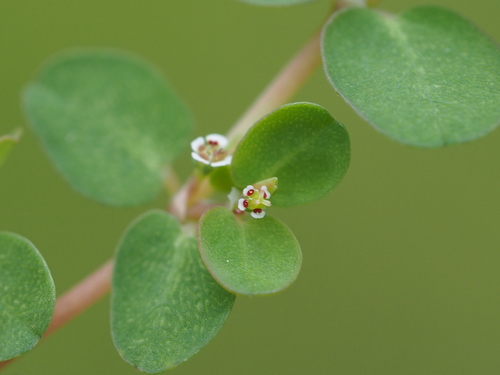
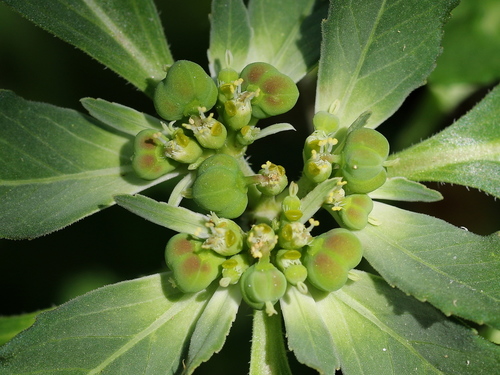
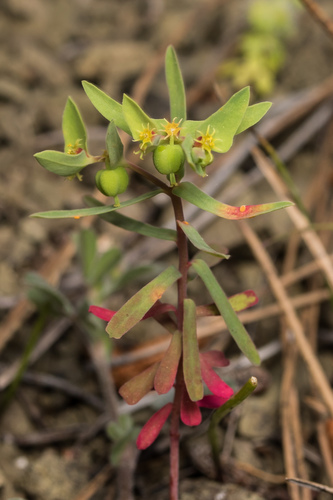
Euphorbia taurinensis All. is a small hairless annual plant that grows to 20 to 30 cm tall. It has two-horned flower glands, with horns that are notably long relative to the gland body, though this is not always the case. Its fruits measure 2.5 to 3.5 mm, have three rounded lobes, and the raised humps on the lobes have a grainy texture. All of its leaves are untoothed. Stem leaves are well-spaced and narrow; their tips may be pointed or indented, and they often broaden toward the end. Raylet leaves located near the flowers range from broad to slender, and may sometimes be quite narrow while retaining some width. Its seeds are 2 mm long, ovoid in shape, and are irregularly pitted or net-like (reticulate) but not furrowed. Seeds are pale grey, with darker color within the pits, and have a prominent, roughly hemispherical white caruncle (seed appendage). Illustrations of this species can be found in Iconographia florae italicae, in entry #3 of the Flora of the USSR, and photos are available on iNaturalist. This species can be confused with other related species that generally have opposite distinguishing traits: short or absent gland horns, angular fruit lobes, unlobed fruits, or fruits without grainy lobe humps, densely arranged stem leaves (for example in E. exigua and E. aleppica), very narrow raylet (flower) leaves (seen in E. ledebourii, which usually has longer leaves overall), or seeds that are furrowed or differ in other features. This species occurs in Europe except for northern Europe, Turkey, and the North Caucasus. Documented specific locations include Albania, the Baleares, Bulgaria, Corse, Cyprus, Czechia, Slovakia, the East Aegean Islands, France, Germany, Greece, Hungary, Italy, Kriti, Krym, North Caucasus, Portugal, Romania, Spain, Switzerland, Turkey, Turkey-in-Europe, Ukraine, and Yugoslavia, according to the PoWo map. In Europe, it grows on disturbed ground. In Turkey, it grows in woodland dominated by Quercus/Phillyrea or Pinus brutia, as well as in macchie, phrygana, stony places, marshy meadows, and fallow fields, at elevations between 0 and 1500 m.