About Euphorbia stygiana H.C.Watson
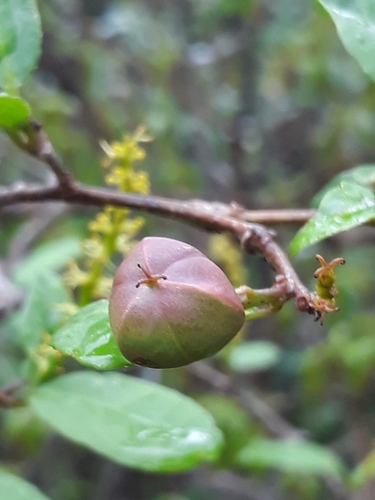
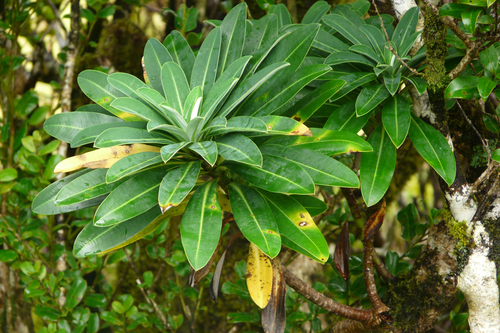
Euphorbia stygiana is an evergreen shrub with low, robust, serpentine green stems, thick leathery blue-dark green leaves with white veins, and large yellow-green flower heads that carry a strong honey scent from May to June, during spring and summer. In its native environment, it can reach up to roughly 10 metres (33 ft) tall, but cultivated specimens are typically 1.5 metres (4.9 ft) tall, and spread to around 1.5 metres (4.9 ft) wide. Its leaves measure 7–14 cm long by 1.5–3.5 cm wide (2.76 in–5.51 in × 0.59 in–1.38 in), and are slightly pubescent on their lower surface. The plant's fruits are 5–7 millimetres (0.20–0.28 in) across, striated, warty, and subglobose. During cold winters, particularly when grown outside the species' native range, its leaves may turn a striking brilliant crimson. It is hardy down to USDA Zone 8b, tolerating temperatures as low as −9.4 °C (15.1 °F), and can be propagated from stem cuttings.
This species is endemic to all Azorean islands except Graciosa. It grows in the extremely humid highlands of the archipelago, at altitudes between 300 and 1,100 metres (980 to 3,610 ft), and is found most often on Pico Island, in sheltered locations including ravines, craters, and dense laurel-Juniperus forests.
Like other species in the Euphorbia genus, E. stygiana produces milky white sap. Contact with skin or eyes may cause skin irritation or an allergic reaction, and the plant is toxic if consumed.