About Euphorbia schinzii Pax
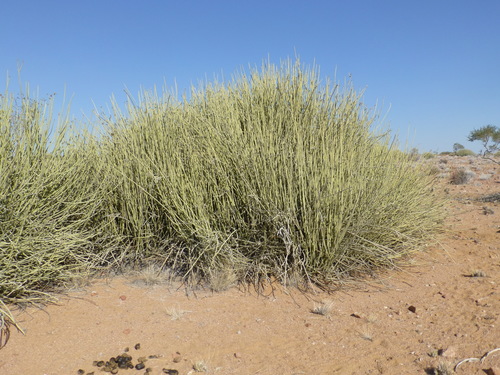
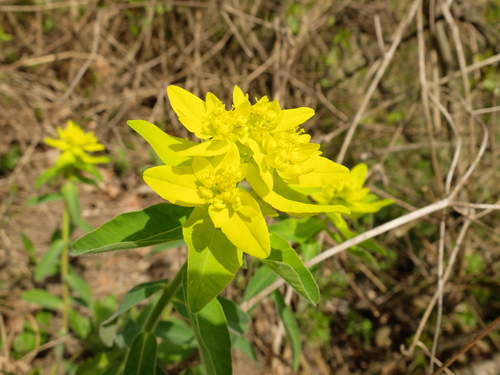
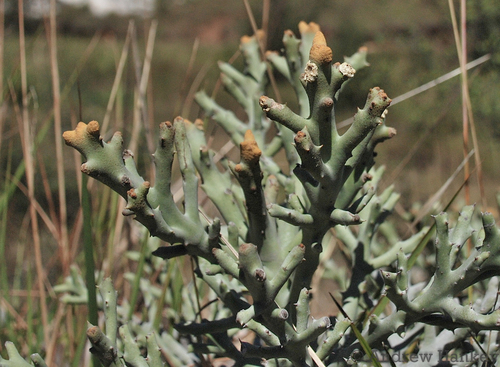
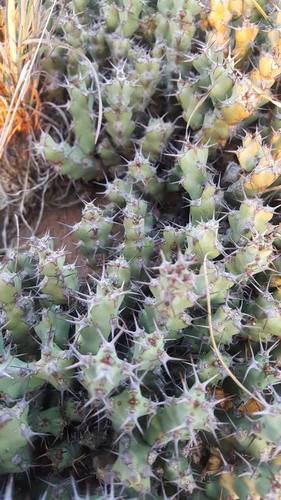
Euphorbia schinzii Pax is a perennial dwarf flowering plant in the Euphorbiaceae family, native to Southern Africa. It grows on rocky slopes among rocks. Morphologically variable, this species occurs across South Africa, Zimbabwe, Botswana, Mozambique, and Malawi at altitudes ranging from 100 to 1500 meters. The genus Euphorbia is a large, globally distributed group that includes over 2000 species with extremely diverse sizes and appearances. Euphorbia schinzii itself is a dwarf, leafless, spiny succulent. It forms a tuberous rootstock at or just below ground level, and produces numerous erect, somewhat woody branches 8 to 10 mm in diameter that grow 10 to 15 cm tall. Branches are usually 3-angled, and carry paired spines. Each tooth of the branch bears two pairs of spines: a small minute pair at the tooth base, and a much longer diverging pair at the tooth apex, in dark brown or grey. Vestigial leaves are shed early in development and are rarely observed on the plant. Spine-shields are narrow, dark brown, and do not form a continuous horny margin. Bright yellow, glabrous cyathia (flowers) that are around 3 mm in diameter appear in groups of three on short cymes near the upper end of branches. These cyathia have 5 glands and 5 broadly obovate fringed lobes. The ovary is sessile and sits enclosed within the involucre. Styles are shortly joined at the base, and minutely split into two lobes at the apex. The seed capsule is sessile and partially extends out from the involucre, measures about 3 mm in diameter, and is 3-lobed when viewed from above. When ripe during the first spring rain, the capsule explodes with force to disperse its seeds. This species is pollinated by insects including flies, bees, and wasps. Powder made from its dried roots is rubbed into cuts on the breasts to act as a galactagogue. The species was first formally described in 1898 in Bulletin de l'Herbier Boissier 6: 739, and is named to honor Swiss botanist Hans Schinz.