About Euphorbia purpurea (Raf.) Fernald
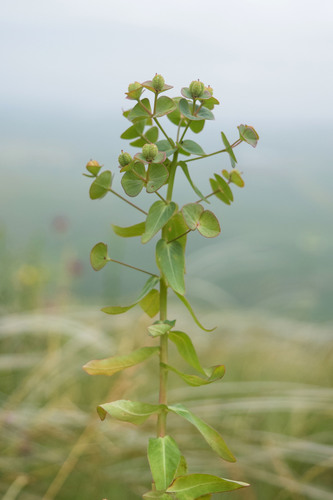
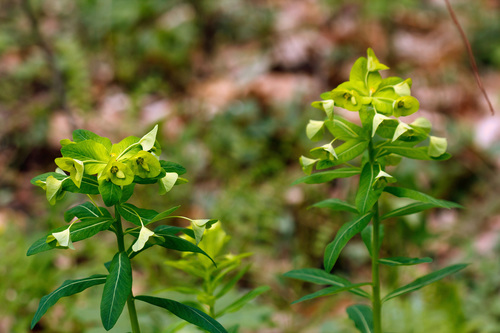
Euphorbia purpurea (Raf.) Fernald is a species of Euphorbia with common names Darlington's glade spurge, glade spurge, and purple spurge. It is native to the Eastern United States, where it occurs from Ohio and Pennsylvania south to North Carolina. It has been extirpated from Alabama, and it was thought to be lost from Delaware until a population was rediscovered there in 1997. This perennial herb grows from a rhizome and reaches a maximum height of around one meter. It has slightly hairy, oppositely arranged leaves that grow up to 3 centimeters long. Its bracts are purplish, which gives the species its name. The bumpy fruit of this plant is about 6 to 8 millimeters long. Flowering occurs in May and June. The plant is easy to propagate from cuttings, and roots readily. This species grows in dry, moist, and swampy wooded areas, as well as mountain glades. It often grows in saturated soils around seeps near streams. It is not strictly a wetland species, and can also grow in dry locations. It grows in both full shade and full sun. In wetter areas it may grow alongside Polemonium vanbruntiae, Carex mitchelliana, C. leptalea, Chrysosplenium americanum, Glyceria striata, Cirsium muticum, Rhamnus alnifolia, Scirpus rubrotinctus, Triadenum walteri, and Penthorum sedoides. It has been recorded growing with Sphenopholis pensylvanica, Caltha palustris, and Viola conspersa in a swampy area. It can also be found in deciduous forest habitat alongside species including Quercus muhlenbergii, Fraxinus quadrangulata, Cenchrus occidentalis, Viburnum prunifolium, Quercus rubra, Hydrangea arborescens, Aquilegia canadensis, Thalictrum dioicum, Carex eburnea, Impatiens pallida, and Phlox divaricata. There are around 50 known occurrences of this plant across seven or eight states. Threats to the species include herbivory from animals such as deer and groundhogs. It is also threatened by loss and degradation of its habitat, caused when wetlands are filled in, and moist seeps and streams dry out. Logging may be a threat in some areas. Grazing appears to benefit the species by reducing competition from other plants, however overgrazing and trampling can be problematic, and some historical populations in eastern Pennsylvania were eliminated by grazing.