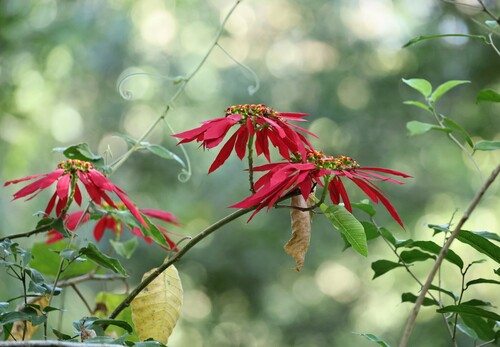
About Euphorbia pulcherrima Willd. ex Klotzsch
Euphorbia pulcherrima, commonly known as poinsettia, is a shrub or small tree that typically grows 0.6–4 metres (2–13 ft) tall. It has dark green, toothed leaves that are 6–16 centimetres (2.4–6.3 in) long. The brightly colored structures, which are most often flaming red, while cultivars come in orange, pale green, cream, pink, white, or marbled, are actually modified leaves called bracts. They are often mistaken for flower petals due to their color and arrangement. Bract color develops through photoperiodism: plants require at least 14 consecutive hours of darkness daily for 6–8 weeks straight to change color, and need abundant daytime light to produce the brightest bract colors. This species is semi-evergreen, and generally loses most of its leaves during winter. Poinsettia flowers are small and inconspicuous, grouped into structures called cyathia, which are small yellow structures located at the center of each bunch of bracts. Nothing is known about pollination of wild poinsettias, though wasps have been observed occasionally visiting cyathia. All species in the Euphorbiaceae family have unisexual flowers (each flower is either male or female only), and these flowers are often very small. In the genus Euphorbia, flowers are even more reduced before being aggregated into a clustered inflorescence. Extrafloral nectaries on E. pulcherrima were first reported by Zimmerman in 1932.
Wild poinsettias are native to North and Central America, ranging from Mexico to southern Guatemala. Their distribution forms a strip roughly 2,000 km (1,200 mi) long, found in mid-elevation tropical dry forests. Most wild populations grow on Pacific-facing slopes in steep canyons. Populations once occurred in rolling hill areas, but many of these populations are now extinct. Researchers have hypothesized that the inaccessibility of steep canyons protects remaining wild populations from human disturbance. There is an atypical wild population in northern parts of the Mexican states of Guerrero and Oaxaca, located much further inland in hot, seasonally dry forests than the rest of the species’ natural range. Genetic analyses have found that the wild population in northern Guerrero is likely the ancestor of most cultivated poinsettias.
A widespread but incorrect myth claims poinsettias are toxic to humans and animals. This misconception originated from a 1919 urban legend that a two-year-old child died after eating a poinsettia leaf. In 1944, H. R. Arnold included poinsettias in his book Poisonous Plants of Hawaii based on this false claim. Though Arnold later acknowledged the story was hearsay and poinsettias had not been proven poisonous, the idea that they were deadly persisted. In 1970, the US Food and Drug Administration incorrectly stated in a newsletter that “one poinsettia leaf can kill a child”, and in 1980 poinsettias were banned from nursing homes in a North Carolina county over the supposed toxicity. Experiments testing poinsettia toxicity in rats found no negative effects even at experimental doses equivalent to consuming 500 leaves, or nearly 1 kg (2.2 lb) of sap. Exposure to any part of the plant often causes no symptoms in children or pets, though ingesting the plant may lead to nausea, diarrhea, or vomiting. Some people develop a skin rash after external exposure. A review of more than 20,000 poinsettia exposure calls to the American Association of Poison Control Centers between 1985 and 1992 recorded zero fatalities. 92.4% of exposure calls reported no effects at all, and only 3.4% reported minor, minimally bothersome effects. For cats and dogs, poinsettia exposure also rarely requires medical treatment. If ingested, mild drooling or vomiting may occur, and diarrhea is rare. Rarely, eye exposure can cause eye irritation. Skin exposure to the plant sap may cause itchiness, redness, or swelling. In certain groups of people, poinsettia exposure can trigger asthma and allergic rhinitis.
The Aztecs were the first group to cultivate poinsettias. Cultivation in the United States began in the 1820s, when diplomat Joel Roberts Poinsett sent samples of the plant back to his greenhouses in South Carolina. Specific details of the plant’s spread from this point are largely unconfirmed, but Colonel Robert Carr exhibited it at the Pennsylvania Horticultural Society’s 1829 Philadelphia Flower Show. Carr described it as “a new Euphorbia with bright scarlet bracts or floral leaves, presented to the Bartram Collection by Mr. Poinsett, United States Minister of Mexico.” The poinsettia is the most economically important potted plant in the world. In the United States, approximately 70 million poinsettias worth US$250 million are sold over a six-week period each year. In Puerto Rico, where poinsettias are grown widely in greenhouses, the local poinsettia industry has an annual value of $5 million. Over 100 cultivated poinsettia varieties have been granted patents in the United States. To produce the extra axillary buds required for plants that bear multiple flower clusters, growers use a phytoplasma infection, which naturally causes increased axillary bud proliferation. Ing-Ming Lee of the USDA Agricultural Research Service is credited with discovering that phytoplasmas promote axillary bud growth in poinsettias.