About Euphorbia ophthalmica Pers.
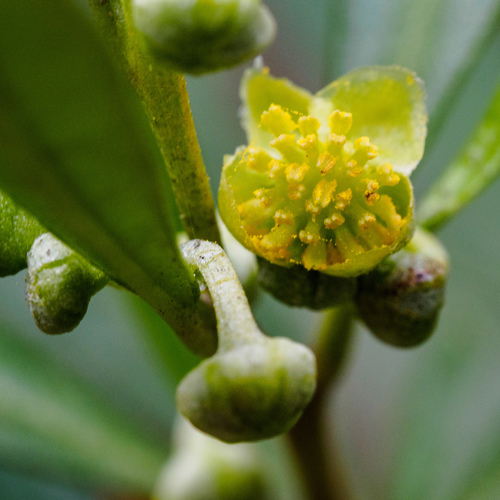
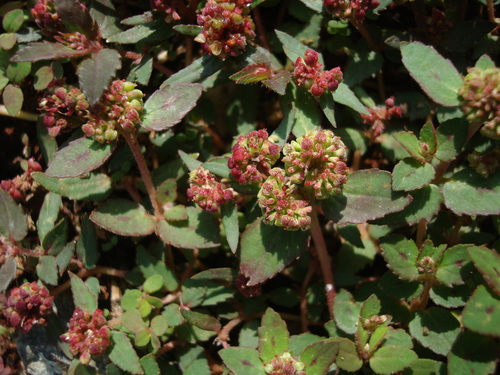
Euphorbia ophthalmica Pers. is an annual or short-lived perennial herb with a slender to slightly thickened taproot. It grows flat against or very close to its growing substrate, forming dense mats, and is often classified as a weed. The entire plant has varying degrees of hair coverage, most commonly with somewhat stiff hairs that lie bent close to the plant surface. Its leaves grow in opposite pairs, have asymmetric bases, and sit on petioles up to 1.2 mm (3⁄64 inch) long. Leaf blades can reach up to 13 mm (~½ inch) long and 7 mm (9⁄32 inch) wide, are shaped ovate or oblong, have three veins starting from the base, and have margins cut with coarse, low teeth. Most green leaf blades have a distinct red spot at their center; when wounded, the plant produces a toxic white sap, commonly called latex. At the tips of stems, the cyathium-type false flowers (called pseudanthia) are characteristically densely arranged into somewhat flat-topped inflorescences. The cup-shaped cyathia hold 4 yellow-green to pink glands, which sometimes have thin, white to pink outer rims. Each cyathium contains between 2 and 8 male flowers, plus a single female flower with a hairy ovary, whose styles are split from halfway to nearly their full length. The fruit is a capsule, ovoid in shape, covered in hairs, and grows up to 1.3 mm (1⁄20 inch) tall. Seeds are orange-brown to pinkish, narrowly ovoid, and have a nearly smooth surface. Euphorbia ophthalmica is very frequently misidentified as Euphorbia hirta. E. hirta is larger and more delicate in structure than E. ophthalmica, and its inflorescences grow both at stem tips and from short, leafless branches that emerge at the points where leaf petioles attach to stems. By contrast, E. ophthalmica inflorescences grow strictly at the tips of leafy stems. Euphorbia ophthalmica flowers and bears fruit year-round, and grows in a range of different disturbed sites, including lawns and roadsides. In the United States, it grows in hammock forests, and in the Bahamas it can also be found in burned-over pine woods. In Mexican traditional medicine, the white latex and stems of this species have been used both cooked and raw to treat pimples, boils, sores, and "mesquinos"—a term referring to warts, or larger patches of rough grainy skin caused by Human papillomavirus infection. All parts of Euphorbia ophthalmica are toxic, and should not be ingested.