About Euphorbia myrsinites L.
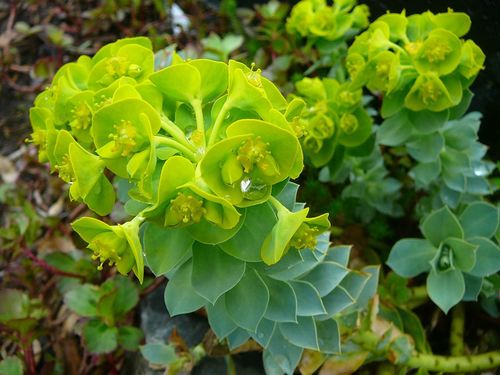
Euphorbia myrsinites, commonly called myrtle spurge, is an evergreen perennial plant. It produces sprawling stems that reach 20 to 40 centimeters in length. Its leaves are spirally arranged, fleshy, and pale glaucous bluish-green, measuring 1 to 2 centimeters long. Its actual flowers are inconspicuous, but they are surrounded by bright sulphur-yellow bracts; the cultivar 'Washfield' has bracts tinged red. Flowers are produced during the spring. This species spreads mainly by seed, and can project its seeds up to 15 feet away from the parent plant. Myrtle spurge is native to southeastern Europe and Asia Minor, ranging from the Balearic Islands and Italy eastward through the Balkans to Crimea, Turkey, the Caucasus, and Iran. The milky sap of myrtle spurge can cause severe skin and eye irritation in humans; if sap contacts the eyes, it may lead to blindness. Ingesting the plant causes nausea, vomiting, and diarrhea. People removing myrtle spurge often wear goggles, gloves, and other protective gear when working with the plant. Children are more susceptible to developing symptoms from exposure than adults, so it is recommended that play areas are not placed near this species. Pets can experience similar negative reactions when exposed to myrtle spurge sap. Euphorbia myrsinites is cultivated as an ornamental plant valued for its distinctive silver-gray foliage. It is used in garden borders, 'modernist' mass plantings, and grown as a potted plant. It is commonly planted in drought-tolerant gardens in California and other dry climates. Cultivated plants grown in the United Kingdom have earned the Royal Horticultural Society's Award of Garden Merit.