About Euphorbia mammillaris L.
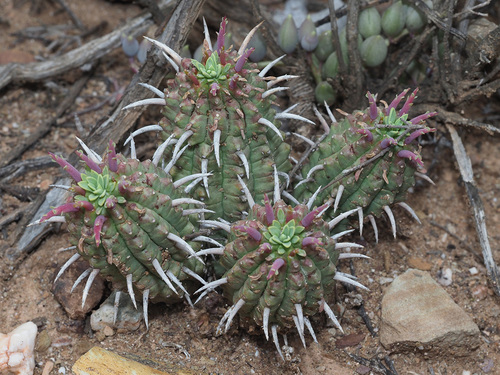
Euphorbia mammillaris, which is very often misspelled as Euphorbia mamillaris, is a plant species endemic to Cape Province, South Africa. It is commonly called African corn-cob or Indian corn-cob, and is a fast-growing shrub succulent. It has thick, chalky green, erect, ribbed stems, and mature plants reach 1 to 2 feet in height. Each stem grows 7 to 17 vertical rows of thick, adjacent hexagonal tubercles that form ribs, giving the plant a characteristic corn-cob appearance. Its pseudo-spines are pinkish white, thick, pointy and blunt like toothpicks, growing up to 1 centimeter (0.4 inches) long and scattered across the tops of stems. A variegated cultivar, E. mammillaris variegata, is typically beige-white when grown under shade, covered by trees, other plants, or rocks; when exposed to more sun, during drought, or in colder weather, its white stems develop tints of magenta, fuchsia, and rosy-pink. From late winter to early summer, each stem produces small red and orange flowers. The species scientific name refers to its superficial resemblance to Mammillaria cacti, a group of American cacti. Ironically, most Mammillaria cacti are globular, low-growing plants, while Euphorbia mammillaris has a vertical, columnar growth habit, and it is not a true cactus at all. Like all Euphorbia plants, Euphorbia mammillaris is toxic if ingested, and contains caustic latex sap that drips heavily when the plant is damaged. Care is required when handling this plant, and gloves should be worn. If the sap gets into open skin wounds, or onto any mucous membrane such as the eyes, mouth, ears, or nose, it is likely to cause burning pain and an allergic reaction. In extreme cases, especially after oral contact, throat swelling may develop, which can lead to anaphylactic shock, suffocation, and possible death.