About Euphorbia maculata L.
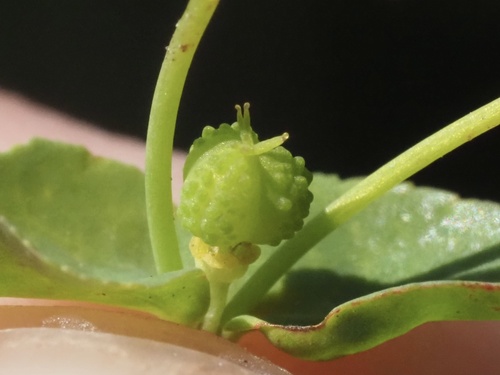
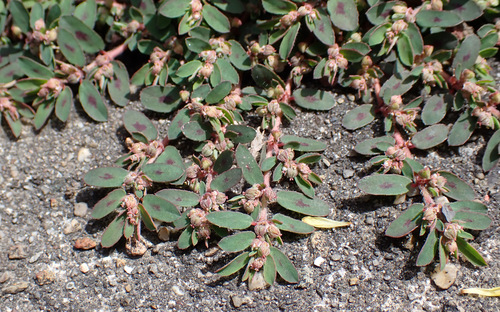
Euphorbia maculata was first described scientifically by Carl Linnaeus in 1753. It is an herbaceous plant that grows with a generally prostrate growth habit, with specimens rarely reaching 30 centimeters (12 inches) tall. Its stems spread out along the ground in a mat, and each stem is rarely longer than 45 centimeters (18 inches). It bears small, opposite leaves that are oblong, elongate oval, and up to 3 centimeters (1.2 in) long. The leaves are pilose, meaning they are covered in small thin hairs, they usually have scalloped (crenate) edges, and each leaf has a small brown spot at its center, a feature that gives the plant its common name spotted spurge. The bisexual reproductive structures unique to the Euphorbia genus, called cyathia, are very small, with four white petal-like appendages that are sometimes pink. This species flowers in summer; the flowers develop in clusters near axillary buds, are small and leaf-like with a red calyx, and have lobed white to pink petals when open. After flowering, it produces a small, 3-lobed fruit covered in fine soft hairs like the rest of the plant. Each lobe is a capsule holding a single seed. The seeds are small, oblong, white to light brown, with an uneven surface pitted with small divots. Euphorbia maculata is similar to Euphorbia prostrata, but E. prostrata has shorter leaves that are more rounded at the tips. It can also occasionally be confused with Euphorbia serpens, which has very short rounded leaves and larger though still inconspicuous cyathia. According to the United States Department of Agriculture, Euphorbia maculata is native to all of the continental United States. It has become naturalized across much of the world, including South America, Australia, Asia, parts of Africa, and all of Europe. It is commonly found along roadsides, in sidewalk cracks and crevices, and throughout North America, growing in sunny, arid areas with little shade. It grows well in coarse soils such as sand or gravel, but can also grow in compacted soils and poor soils, and grows best in full sun conditions. Like most members of the Euphorbiaceae family, Euphorbia maculata is considered toxic. It produces a thin, white milky sap when a leaf or stem is broken, which contains the plant’s toxins. Exposure to the sap may cause mild skin irritation that becomes worse when the affected area is exposed to sun, stomach irritation, and vomiting, and the plant is generally considered a carcinogen. Contact with the eyes, skin, or mouth should be avoided. Across most of North America, Euphorbia maculata is classified as a weed. In Asia, however, it is used as a medicinal plant. The species contains triterpenoids that have anti-inflammatory and anti-proliferative properties when used medicinally. Ingesting the sap acts as a laxative or to induce vomiting, while topical application of the plant is used to treat sores, lesions, warts, and soreness.