About Euphorbia heterophylla var. cyathophora (Murray) Griseb.
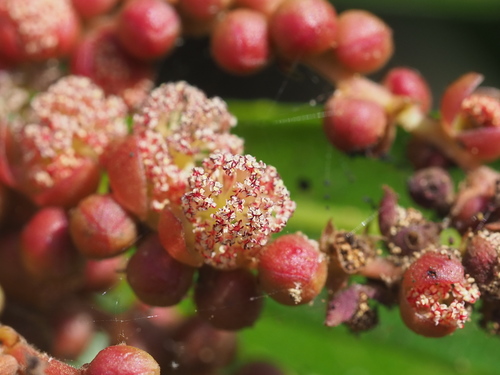
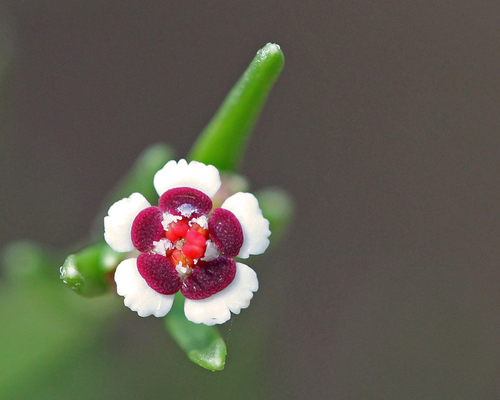
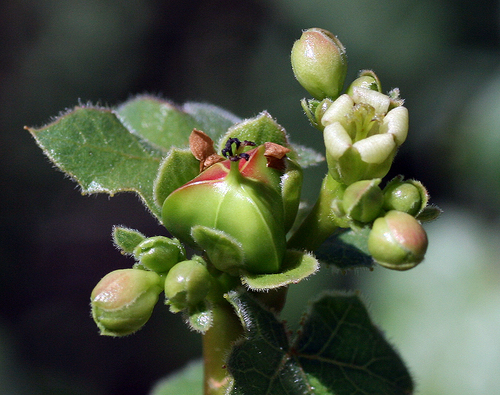
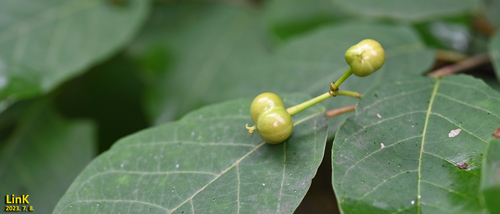
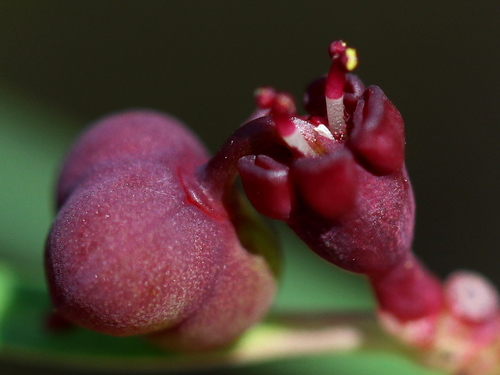
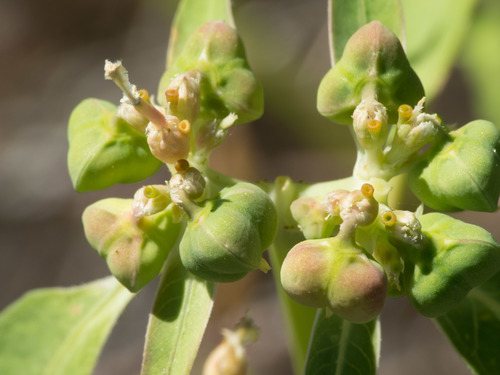
Euphorbia heterophylla grows 30 to 100 cm tall. It has hollow stems that may be simple or branched, with angular ribs. Leaf shapes are variable both within individual plants and across populations. Lower leaves are alternate, while upper leaves are opposite, and most upper leaves have a whitish or bright red base. This plant can flower within 30 days after emergence, and ripe seeds form 25 to 30 days after flowering. It is pollinated by insects, which are drawn to the large volumes of nectar the plant produces. Extrafloral nectaries located at the flowers of E. heterophylla were first reported by Zimmerman in 1932. The plant’s stalk exudes a toxic milky white latex. Its false flowers, called cyathia, grow in clusters at the top of the stalk. These cyathia are yellowish green and have no petals; any visible red color comes from the pigmentation of the plant’s young upper leaves. Fruits are small, segmented capsules. When mature, these capsules explode, launching seeds some distance away from the parent plant to enable dispersal. When this species grows as a wild weed, it often loses its characteristic leaf coloration. Populations with resistance to specific herbicides have been recorded in South America. Euphorbia heterophylla is native to tropical and subtropical America, but is now widespread across all tropical regions. Many herbicides cannot control this plant, so it has spread rapidly to many parts of the world. It was introduced to South and Southeast Asia as an ornamental plant, and has since become an invasive weed in India and Thailand, where it invades cotton fields and other agricultural land. Toxicity is documented for most species in the genus Euphorbia. People who are sensitive to latex can experience strong reactions, including dermatitis and anaphylaxis, after contact with the latex this plant exudes.