About Euphorbia esula L.
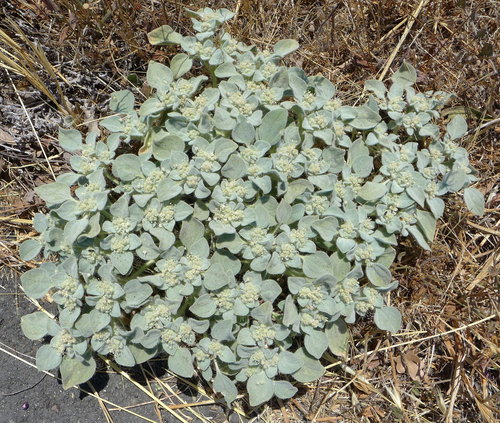
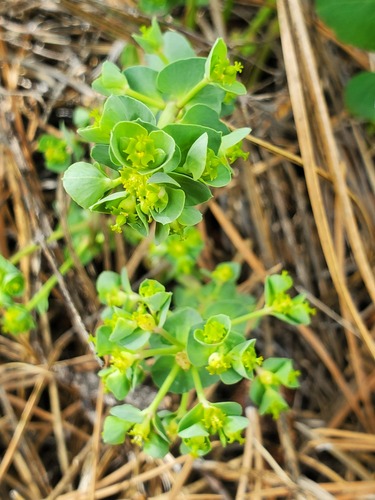
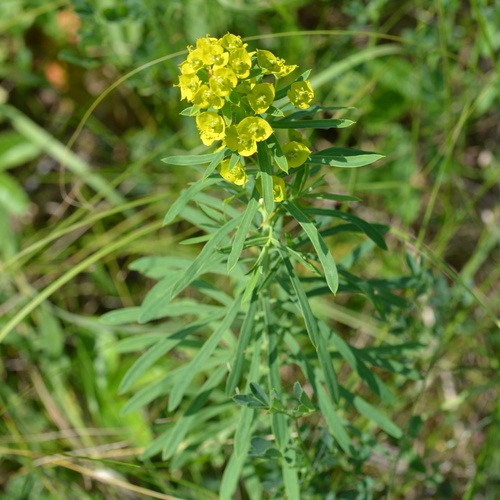
Euphorbia esula L. is a herbaceous perennial plant that grows 1 to 1.2 meters tall. It produces several stems that branch from its base. Stems are smooth, and can be hairless or slightly hairy. Leaves are small and lanceolate, measuring 4 to 8.5 centimeters long and up to 1 centimeter broad, with slightly wavy margins. Its flowers are small, borne in umbels that have a basal pair of bright yellow-green petal-like bracts. Bract clusters emerge in late spring, while the actual flowers do not develop until early summer. All parts of this plant contain a toxic white milky sap. It reproduces readily from seeds, which have a high germination rate and can remain viable in soil for at least eight years. Seed capsules open explosively to disperse seeds up to 5 meters away from the parent plant, and seeds can be carried further by water and wildlife. Leafy spurge also spreads vegetatively through its complex root system; roots have been reported to reach 8 meters deep and 5 meters across, and may produce numerous buds. There are two subspecies and one hybrid subspecies of Euphorbia esula L. Euphorbia esula subsp. esula has leaves that are broadest near the apex, with umbel bracts 5–15 mm long, and occurs across the entire natural range of the species. Euphorbia esula subsp. tommasiniana (Bertol.) Kuzmanov (synonyms: E. waldsteinii (Sojak) A.R.Smith; E. virgata Waldst. & Kit.) has leaves that are broadest at the middle, with umbel bracts 12–35 mm long, and is native to Eastern Europe and western Asia. Euphorbia esula nothosubsp. pseudovirgata (Schur) Govaerts is a hybrid between the two previously described subspecies.