About Euphorbia cyparissias L.
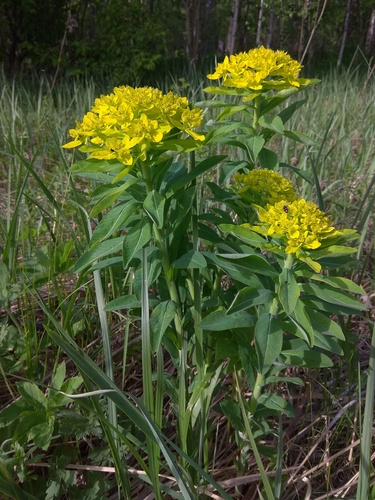
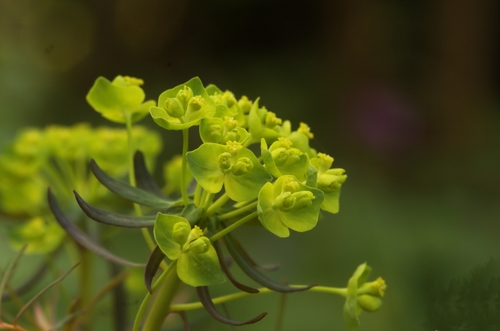
Euphorbia cyparissias L. grows between 20 cm (8 inches) and 40 cm (16 inches) tall. Its petal-like bracts are typically green-yellow, and mature to purple or red between May and August. When the fruit reaches maturity, it explodes to spread seeds up to 5 m (16 ft) away. This species also reproduces via lateral root buds, which let it form dense, widespread stands. It can be identified by its small, linear leaves, which grow up to 4 cm (1.6 in) long and only 1 to 2 mm (1⁄32 to 3⁄32 in) wide. In terms of ecology, Euphorbia cyparissias L. is classified as a noxious weed in many areas, including Colorado in the United States. Like some other non-native plants, it invades habitats occupied by native species. It is known to be harmful to cattle and horses, but not to sheep, and can be difficult to control. Biological pest control methods have been trialed, which involved releasing several European insect species into North America. Certain flea beetles have been effective for this control, but there are concerns about introducing non-native insects to the region. Known parasites of this species include Uromyces pisi-sativi, a fungus, and Anthrenus scrophulariae is frequently found growing on this plant. While Euphorbia cyparissias L. is attractive enough for use as an ornamental plant, its invasive growth means spread must be actively controlled; its spread via roots is more invasive than its spread through self-seeding. Regarding toxicity and uses, the roots of this plant have sometimes been used as a purgative, but the plant is poisonous if consumed in large quantities, and animals can be poisoned by eating hay that contains it. Contact with the plant's sap can trigger skin reactions.