About Euphorbia corollata L.
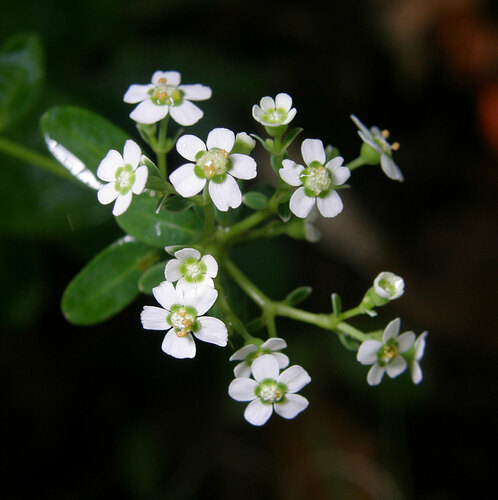
Euphorbia corollata L., commonly known as flowering spurge, is a herbaceous perennial plant in the Euphorbiaceae family native to North America. This species produces a milky sap that can cause skin and eye irritation in some people. It grows up to 1 meter (3 feet) tall, with smooth stems and light green leaves arranged either alternately or in whorls. Individual leaves are roughly 10 mm (1/2 inch) wide and 75 mm (3 inches) long. Each stem ends in a panicle that measures 20 to 25 mm (3/4 to 1 inch) across. The flowers are around 6 mm (1/4 inch) across; each flower structure consists of one pistillate flower and several staminate flowers, surrounded by five white bracts. These bracts are not true petals, and instead develop from the involucre at the base of the flowers. Flowering spurge blooms from June through September. Flowering spurge can grow in most soil types, as long as the soil is well-drained. It is most often found in prairies, pastures, glades, and along roads and train tracks. It has excellent drought tolerance, and develops a deep taproot. Once established, it is difficult to transplant. Its native range extends from Texas north to South Dakota, and east to the Atlantic coast. This plant can be used as a laxative, but it is poisonous when consumed in large quantities.