About Euphorbia condylocarpa M.Bieb.
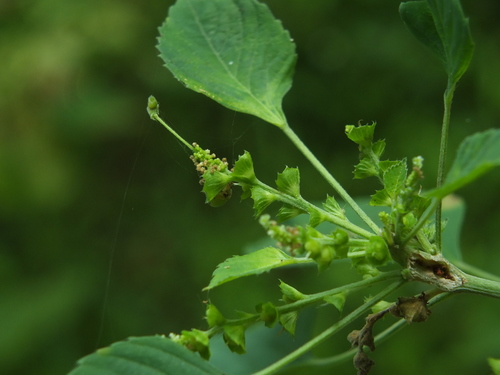
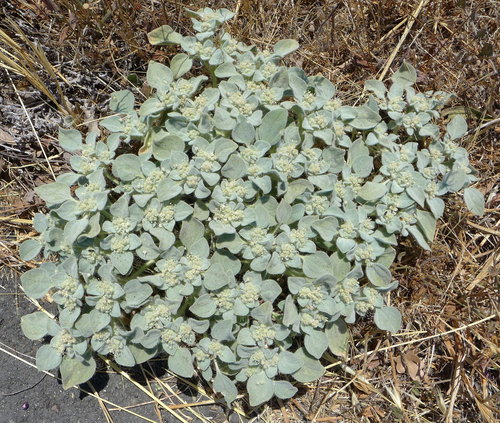
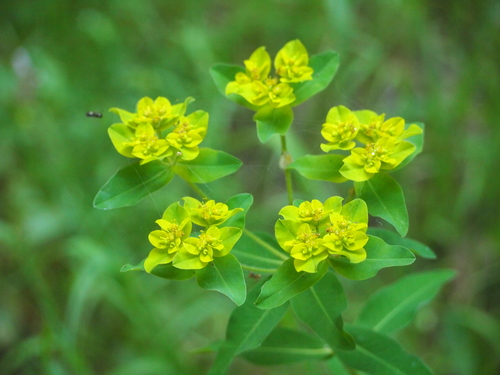
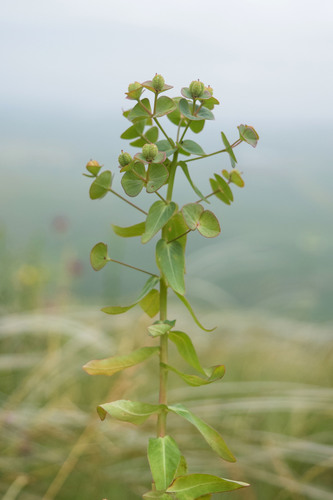
Euphorbia condylocarpa M.Bieb. is a medium-sized hairless perennial plant, growing 10 to 35 centimeters tall. Its leaves have strongly ear-shaped bases, tips that range from blunt to slightly pointed, and margins that are either serrated or toothless. Leaf stalks are absent or very short. The plant produces relatively large capsules, measuring 4 to 5.5 (up to 6) millimeters; these are roughly spherical, with low, wide warts on their three lobes. Seeds are 3 to 3.5 millimeters long, smooth, dark brown, and have a yellowish appendage 0.5 millimeters long. Flowering occurs from March to June in Turkey, and from April to May in Iran. Eastern populations of this species have denser flower heads and more clearly toothed leaves, while Turkish populations have more open, spreading flower clusters and less distinct leaf teeth. Turkish populations were originally classified as a separate species, E. cardiophylla Boiss. & Heldr., but this taxon is now merged into E. condylocarpa. This species can be confused with several similar species: E. apios has leaves that do not have ear-shaped bases; E. dimorphocaulon produces flowering stems in autumn that are nearly leafless, and vegetative stems in spring; E. platyphyllos is an annual that grows up to 1 meter tall, is often hairy, and has fruits that measure 2.5 to 3 millimeters. In Turkey, this species grows in open Pinus forest, Abies cilicica forest, Quercus scrub, rocky slopes, screes, steppe, and field margins, at elevations between 20 and 2100 meters. In Iran, it grows on mountain slopes, in oak forests, meadows, rocky slopes, and steppe forests over limestone, at elevations between 1500 and 2500 meters. The native range of E. condylocarpa includes Iran, Iraq, North Caucasus, Transcaucasus, and Turkey, according to the Plants of the World Online map.