About Euphorbia chamaesyce L.
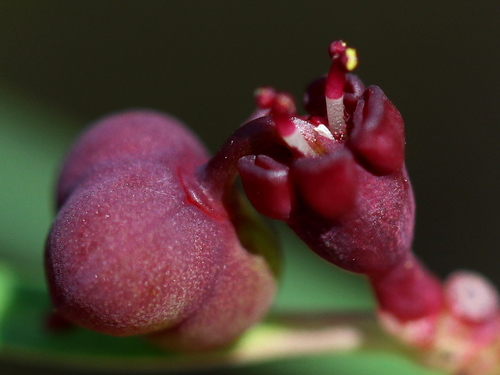
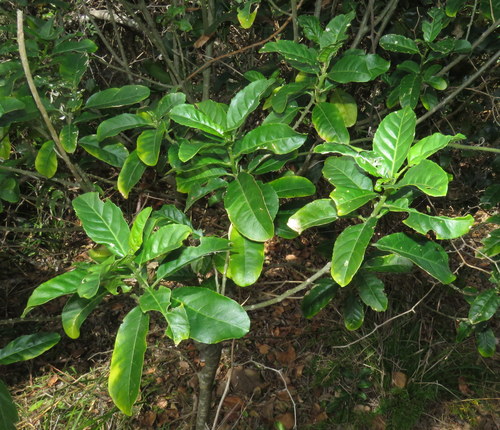
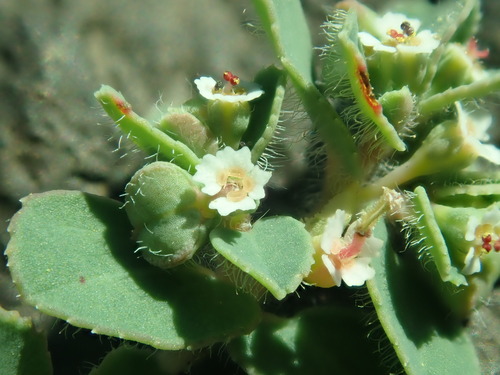
This species is a mat-forming annual Euphorbia that can be hairy or hairless, with leaves that have oblique bases. Leaves are weakly toothed or toothless, can grow up to 7 mm by 4.5 mm, rarely reaching 11 mm by 6 mm, have blunt non-pointed tips, have a slightly to distinctly greyish glaucous appearance, and are borne on 1 mm stalks. Fruits are 2 mm long, can be covered in projecting hairs all over the surface rather than just along the edges or hairless, and have a smooth bumpless surface. The inflorescence structure has small but prominent white or pinkish appendages attached to rounded yellowish or reddish floral glands. Seeds measure 1.2 mm, are ovoid-quadrangular in shape, have an irregularly tuberculate-rugulose surface texture, and are pale greyish. When found in Europe, this species grows alongside other similar mat-forming Euphorbia, and the hairiness of the fruit is the most reliable characteristic to distinguish Euphorbia chamaesyce from these close relatives. Two subspecies are recognized following the treatment in Flora Europaea. Subspecies chamaesyce is hairless or pubescent, has smaller leaves less than 10 mm long that are rather roundish, often untoothed, and usually have a notched tip. The petal-like appendages on its floral glands grow up to twice the width of the gland, so they are no more prominent than the gland itself, and their edges are usually unlobed. Subspecies massiliensis (DC.) Thell. is villous, has larger leaves growing up to 10 mm long that are elongated, finely toothed (serrulate), and have rounded tips. The petal-like appendages on its floral glands are more than twice the width of the gland, so they are more prominent than the gland itself, and their edges are often 3-lobed. This species is native to Europe and Turkey. In Europe, it grows in open habitats. In Turkey, it occurs on rocky hillsides, scree, gravel plains, saline and sandy soils, streamsides, and lake shores, as well as in disturbed habitats, at elevations between 0 and 1600 m. Sources: Flora Europaea, Flora of Turkey