About Euphorbia caducifolia Haines
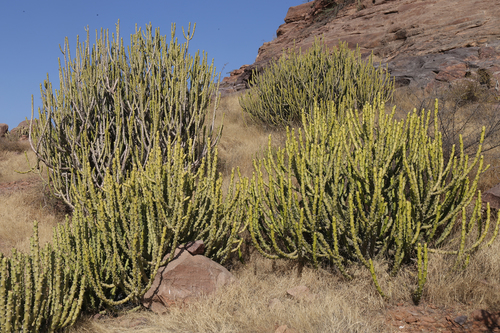
Euphorbia caducifolia Haines grows as a dense, branching bush that reaches up to 3 m (10 ft) in height and 10 m (33 ft) in diameter. Its succulent stems branch frequently and grow in an upright vertical orientation. It produces small oval leaves measuring around 2.5 to 8 cm (1 to 3 in) long and up to 2.5 cm (1 in) wide, and these leaves are quickly shed after forming. Spines growing from the stipules can reach 1 cm (0.4 in) in length. E. caducifolia is similar in appearance to Euphorbia nivulia, commonly called leafy milk hedge, but can be distinguished by its multiple stems and smaller, shorter-lived leaves. Its flowers are orange-red and bloom in February and March. This species has a restricted native range in the Thar Desert, located in the northwestern Indian subcontinent along the border between India and Pakistan. Its natural habitat here consists of sandy hills and shifting sand dunes, an area characterized by clumps of thorny vegetation, low trees, grasses, and scrub. In the vegetated hills of southern Rajasthan, Euphorbia caducifolia grows in association with Butea monosperma, Millettia pinnata, Syzygium hyrianium, Wrightia tinctoria, and Ziziphus nummularia. In the arid region near Sambhar Salt Lake, it grows alongside thorny scrub species including Anogeissus pendula and Boswellia. Like all members of the Euphorbiaceae family, broken or cut tissue of Euphorbia caducifolia releases a large amount of white, latex-like sap that contains phorbol and other alkaloids. This sap can cause severe pain if it comes into contact with mucous membranes such as those of the eyes, mouth, or nose, or if it enters a fresh cut. If sap dries on bare skin and is not washed away quickly, extra care must be taken to avoid touching the eyes or mouth. Accidental ingestion of the plant can cause severe negative gastrointestinal effects. Despite its irritating and potentially poisonous properties, the species has long been used as an anti-tumour agent in Pakistan, and its roots are also reported to have the same anti-tumour effects. The plant's latex has additionally been used to speed wound healing, and research has confirmed that it shows significant wound healing activity, likely due to the latex hardening as it dries when exposed to air. The plant is also a rich source of C-15 hydrocarbon compounds that can be processed to make biodiesel fuel.