About Euphorbia balsamifera Aiton
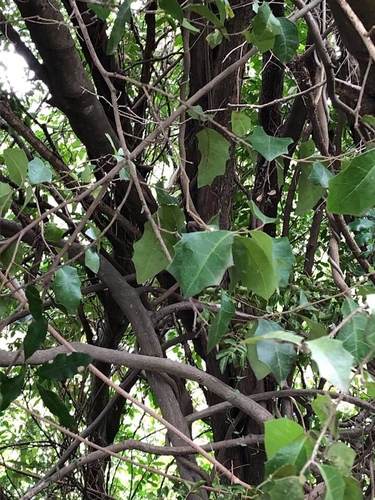
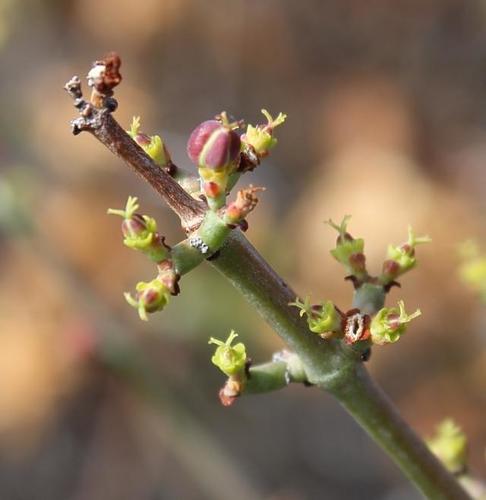
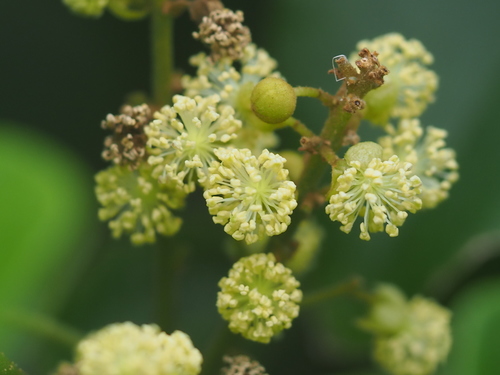
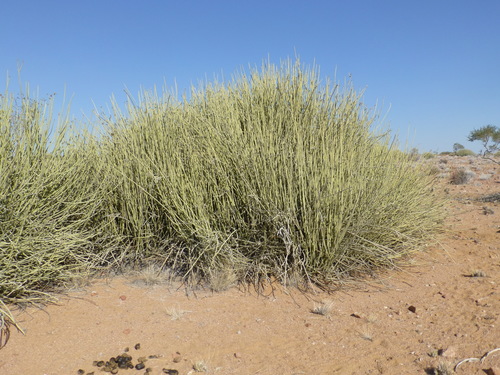
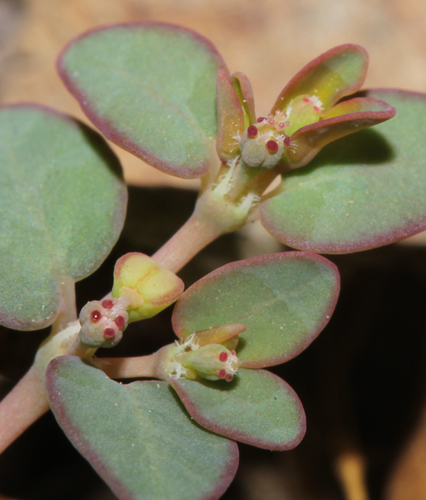
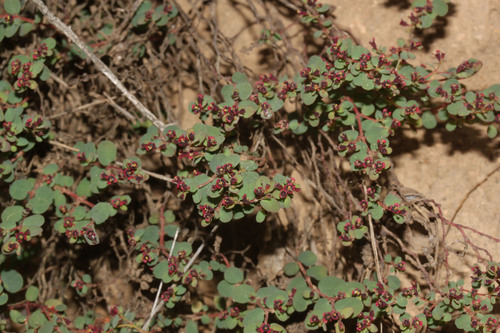
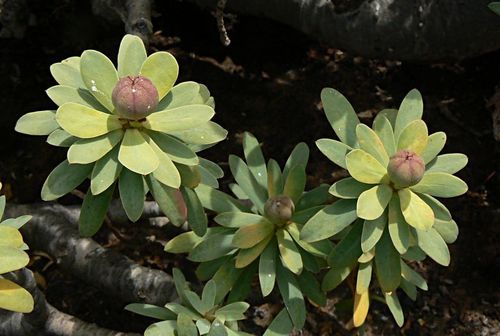
Euphorbia balsamifera Aiton varies widely in growth form and height: it can grow as a low shrub, or as a small tree reaching 2–5 meters tall. Stems are up to 15 cm in diameter, semisucculent, spineless, and covered in transverse leaf scars. Stem color ranges from gray to terra-cotta. Plants branch from the base, with older stem sections gradually becoming knotty and very thick. Leaves measure 80 mm long and 4–8 mm wide, clustered at stem tips. They are green and glaucous, sessile, and range in shape from linear-lanceolate to ovate. Inflorescences are terminal cymes, usually reduced to a single semi-sessile cyathium 6 mm wide at the tip of each stem. The pseudo-petals are yellowish green. The fruit is a large green capsule, 10 mm long and 9 mm wide, that turns pinkish-reddish-green when ripe. It is shallowly lobed, smooth or hairy, and semi-sessile. This species is native to the Canary Islands, western Morocco, and Western Sahara. It grows up to 800 meters above sea level, forming dense communities on rocky ground and sandy dunes (excluding extremely mobile dunes) in plains alongside other succulent plants. Like other Euphorbia species, the milky latex of Euphorbia balsamifera is poisonous, though it is less caustic than that of many other members of the genus. In Morocco, it is widely used in dentistry as an anesthetic for the treatment of acute dental pulpitis. In the Canary Islands, its leaves have traditionally been collected and cooked as a green vegetable. Like most other succulent members of the genus Euphorbia, trade in Euphorbia balsamifera is regulated under Appendix II of CITES.