About Euphorbia atropurpurea Brouss. ex Willd.
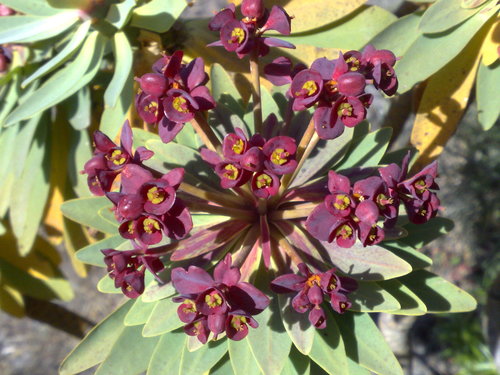
Euphorbia atropurpurea Brouss. ex Willd. is known by the Spanish common names tabaiba majorera and tabaiba roja. It is a shrub in the family Euphorbiaceae, native to Tenerife in the Canary Islands. This species can grow up to 2 metres in height, and some individuals can reach over 2 metres tall. It has succulent, spineless brown stems and branches. It produces large bluish green leaves that form a rosette at the end of each branch. It grows in ravines, on slopes, and on terraces. It thrives best in humid conditions at mid to low altitudes between 300 and 1,200 metres, in the south and western parts of Tenerife. It is abundant in Teno, Santiago del Teide, and on the slope of Güímar. It flowers from winter through spring, between December and May. Its flowers have dark red bracts that measure more than 1 cm across. These dark red bracts give the species its scientific name atropurpurea, which comes from the Latin words ater meaning 'black' and 'purple'. This species should not be confused with Euphorbia bravoana, a different endemic species found on the nearby island of La Gomera that also bears purple-red bracts. Its fruit is a red capsule that holds three dark brown seeds. Like all other plants in the genus Euphorbia, this species produces toxic white latex when cut. It is grown as an ornamental plant in gardens for its striking appearance and flowers. It requires very little maintenance, but does need full sunlight and a specific level of environmental humidity to grow well. It most commonly reproduces by spreading via seeds, and more rarely reproduces vegetatively through branching. Like most other succulent members of the genus Euphorbia, trade of Euphorbia atropurpurea is regulated under Appendix II of CITES. In the Masca region of Tenerife, natural hybrids between E. atropurpurea and Euphorbia regis-jubae occur. Swedish botanist Eric Ragnor Sventenius named this hybrid Euphorbia navae, in honour of Alonso de Nava y Grimón, who founded the Botanical Garden of La Orotava.