About Euphorbia albomarginata Torr. & A.Gray
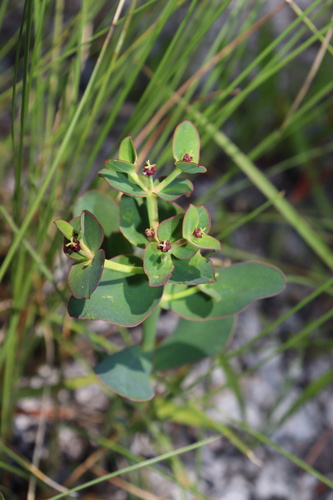
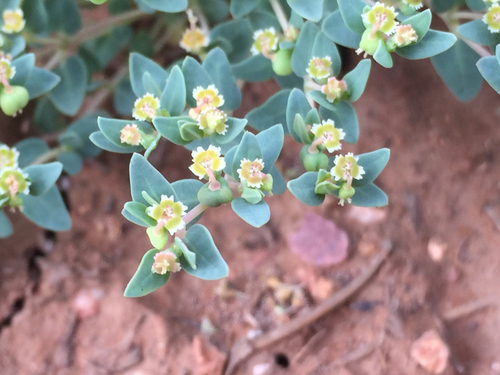
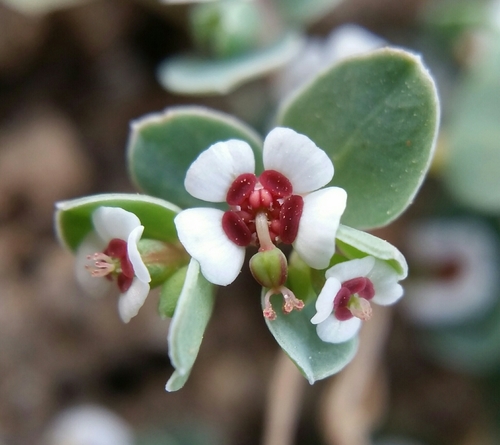
Euphorbia albomarginata Torr. & A.Gray is a common ground cover plant that usually grows less than 1/2 inch (13 mm) high. Individual plants cover roughly one square foot, and they often grow close together to form continuous mats of vegetation. This species produces tiny flowers that have a white edge and a purplish, circular burgundy center, with a white ring surrounding the center. Its species epithet albomarginata, meaning "white-margined", refers to this white ring on the flower's margin. The plant does not produce true petals; instead, it has modified leaves called bracts that are rounder than the plant's other green leaves and form a cuplike shape. Between 12 and 30 tiny male flowers, each consisting of only one stamen, are clustered in the center of the cup, along with a single female flower located at the center that has an elevated ovary hanging from a long stalk. When fertilized and mature, the female flower develops a capsule fruit. Its former genus name Chamaesyce comes from the Greek words chame, meaning "on the ground", and syce, meaning "fig". This name refers to the species' flattened, very low-growing growth habit that lies extremely close to the ground; the term syce refers to the plant's capsule fruit. Chamise (Adenostoma fasciculatum), a defining chaparral plant, gets its name from the same Greek root. The plant's leaves range in shape from round to ovoid (heart-shaped with the pointed tip of the heart facing away from the petiole, the small stem that attaches the leaf to the branch). The non-flowering leaves are a distinctive dusty green, and sometimes have burgundy-toned edges. The plant's stems are also burgundy-toned, matching the color of the flower center inside the white ring; this burgundy color is particularly prominent after late spring or summer rain. Euphorbia albomarginata grows in open fields, roadsides, and any disturbed ground, including ornamental gravel in suburban yards, where it is considered a weed. This plant is commonly called rattlesnake weed because it was formerly used as a folk remedy for snakebites, prepared as either a poultice or a brewed tea. No medical research has proven this species effective for treating rattlesnake venom, however. Like most spurges, rattlesnake weed produces an acrid, milky sap that contains alkaloids poisonous to humans. The sap has emetic and cathartic properties, which have sometimes been misinterpreted as curative effects. Among the Zuni people, the plant's leaves and roots are eaten to promote lactation.