About Euphorbia acuta Engelm.
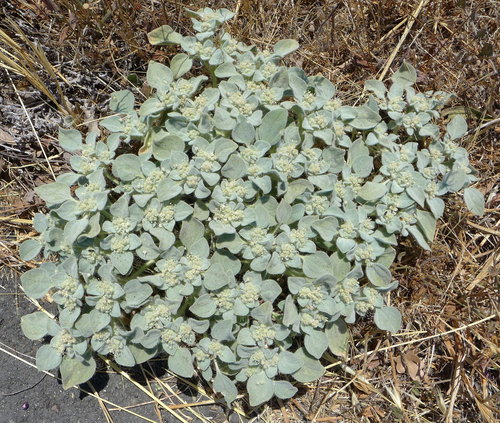
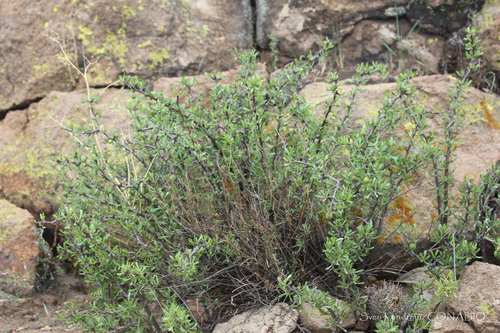
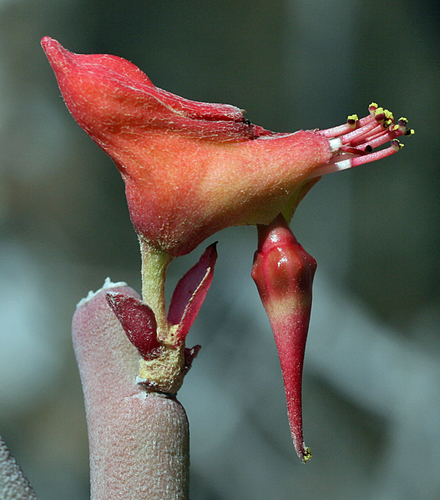
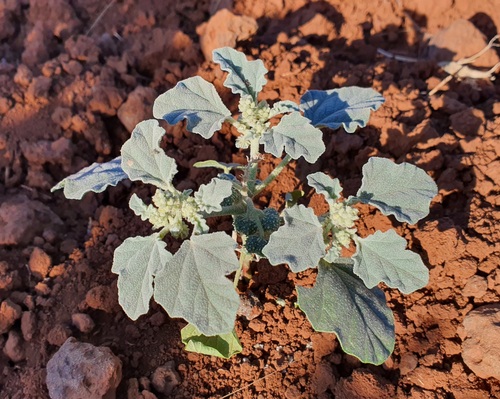
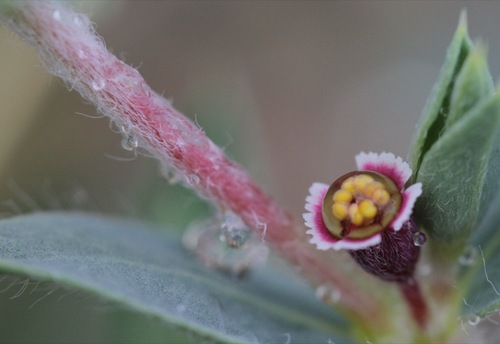
Euphorbia acuta Engelm., commonly called pointed sandmat, is a perennial herbaceous plant with a strongly thickened rootstock. It grows erect, reaching up to 30 cm (12 in) in height. Its leaves and stems are uniformly and densely covered with short to silky white to gray hairs. Leaves grow up to 20 mm (0.8 in) long and 8 mm (0.3 in) wide, with a shape ranging from narrowly ovate to broadly lanceolate. Like all Euphorbia species, Euphorbia acuta produces tiny unisexual flowers. Clusters of male and female flowers are arranged to look like a single small blossom, a structure called a pseudanthium. In the Euphorbia genus, these pseudanthia take a specialized form known as cyathia. Each cyathium of Euphorbia acuta holds 20 to 25 male flowers, each consisting of only a single stamen, that surround one single stalked female flower. As the female flower’s ovary grows larger, its stalk lengthens, and the ovary hangs outside the cyathium as it matures into a seed-bearing fruit. This species is native to the south-central United States, extending into the far northern portions of the northern Mexican states of Chihuahua and Coahuila. In Texas, it grows mainly on dry limestone uplands of the Edwards Plateau, and in shrublands within the semi-arid climate zone. Fewer than 1% of all green plant species use the C2 photosynthetic pathway; most use C3 or C4 photosynthesis instead. Euphorbia acuta uses the C2 photosynthetic pathway. It has been theorized that the C2 pathway helps species that use it cope better with environmental stress.