About Euphonia hirundinacea Bonaparte, 1838
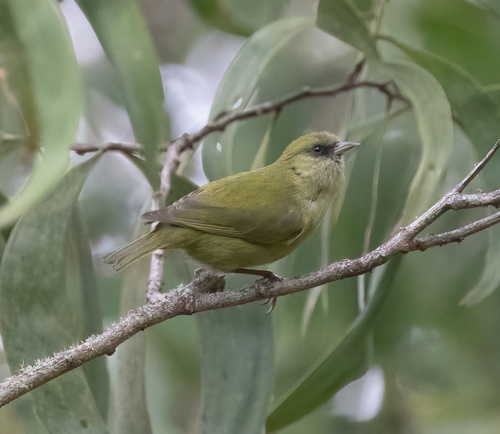
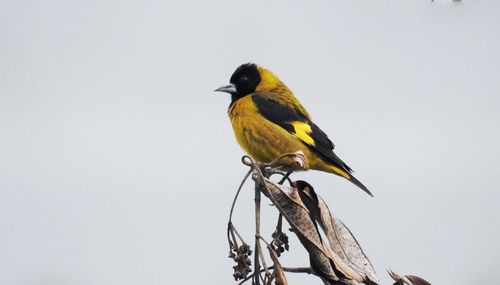
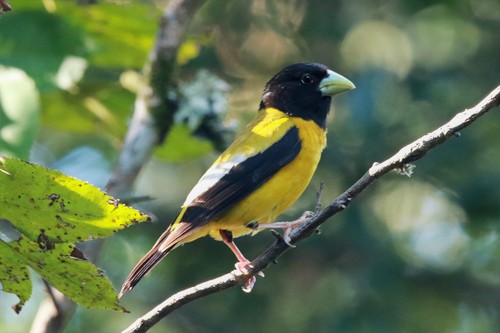
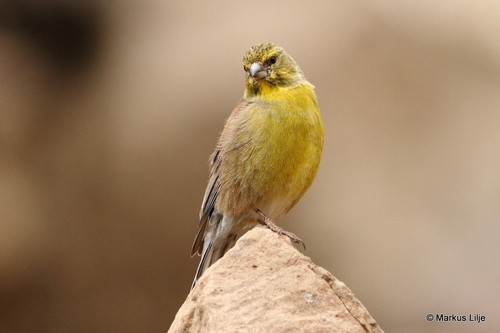
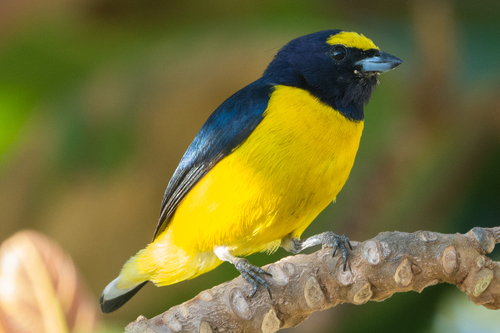
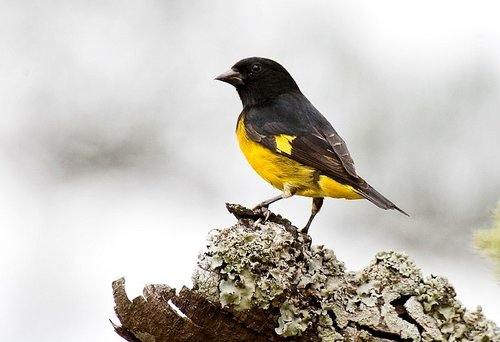
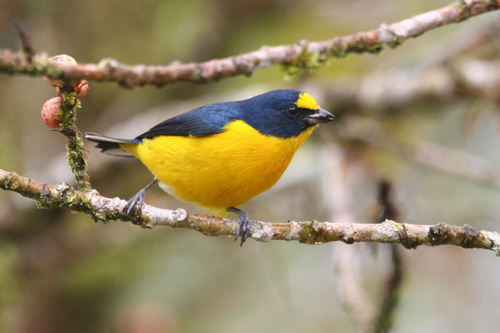
The yellow-throated euphonia (Euphonia hirundinacea Bonaparte, 1838) is a small, short-billed, short-tailed arboreal passerine with pointed wings. Adult individuals measure 10–12 cm in total length, of which the tail contributes 3.3 to 3.6 cm. They have a wingspan of 5.8 to 6.1 cm and weigh between approximately 11.6 and 17.8 g. Adult males of the nominate subspecies have a small bright yellow patch on the forehead that extends backward to roughly the middle of the eyes. The rest of the head, upperparts including upper-wing coverts, and upper-tail coverts are glossy blue-black. Flight feathers are black with steel blue edgings, and all underparts are yellow. Underwing coverts are white, while undertail coverts are a dark dull grey. The inner webs of the outer 2–3 pairs of flight feathers are mostly white, forming a large, white, oval-shaped area on the undersides of the wings. The tip of the beak is black, fading to blue-gray beneath the nostrils and along the lower mandible. Irides are brown, and legs and feet are dusky dark gray. Adult females have faintly glossy metallic olive-green coloration on the top of the head, sides of the head, and upperparts. The throat, center of the breast, and lower underparts are whitish to greyish-white, while the sides of the breast, body sides, and flanks are bright yellowish olive-green. Undertail coverts are pale olive-yellowish, and the beak matches that of the adult male. Juvenile males resemble females, but their plumage has a looser texture, and the olive-green of their upperparts lacks gloss. Immature males also look like females, and first develop yellow feathers on the throat and middle of the underparts, with the entire ventral surface turning yellow before black plumage begins to appear. Males then grow in a black mask, black color across the crown and head, or a crown with mixed black and olive. The back, sides, and wings start as olive-green, and are the last body region to shift to dark blue. The male’s song consists of high-pitched shrill and squeaky notes, that often alternate rapidly in a choppy pattern of 2–4 notes mixed with moderately pitched notes. Some male songs include mimicked notes from other bird species, but males of this species have a smaller repertoire than closely related E. violacea and E. laniirostris. Call notes include a rapid "pidgel-eece," a conversational "chi-bib-bib-bib-bib," a rough hurried "tuck-a-tuck" or "chuck-a-chuck," a clear "weet," and a full-throated "queer" or "gleer." Its calls are described as short and explosive. Female calls are thin, "chaffy" in quality, high-pitched, and nearly trilled. Across most of their geographic range, male yellow-throated euphonias are easily recognized by their yellow throat. They overlap with the similar thick-billed euphonia in southwestern Costa Rica and western Panama; thick-billed euphonia also have a yellow throat, but have more extensive yellow on the crown, and are much more common in areas where their ranges overlap. Female yellow-throated euphonias can be distinguished from females of other sympatric Euphonia species by their whitish or pale grey throat, center of the breast, and belly, paired with yellow flanks. Females of scrub euphonia, thick-billed euphonia, and yellow-crowned euphonia have entirely greenish yellow to yellow ventral parts, and female white-vented euphonia have whitish throats but yellow breasts. The yellow-throated euphonia’s range reaches its northern limit in eastern Mexico, across southern Tamaulipas, eastern San Luis Potosí, northeastern Puebla (east of Huauchinango), and northern Veracruz south to Tuxpan and Tlapacoyan. Its range extends south through Belize, Honduras, El Salvador, eastern Nicaragua, Costa Rica, and western Panama. The subspecies E. h. gnatho occurs in northeastern Nicaragua, Costa Rica (absent from the southwest and Caribbean lowlands), and extreme western Panama. The species inhabits mainly dry to humid regions, including forest borders, second growth, shady plantations, and medium-height dense woodland along river gorges and streams. It occurs from lowlands up to 2100 m in Mexico, and is found primarily in plateau and hill country in El Salvador and Costa Rica. It is presumed to reside in foothills between 900 m and 1200 m elevation in western Panama. It is resident across most of its range, with some local seasonal movement that responds to food availability. In Mexico, it is considered likely only a non-breeding visitor from October to May on the Pacific slope of the Isthmus of Tehuantepec in Oaxaca. It has only been recorded in El Salvador during spring and summer months, so it may be migratory there. The yellow-throated euphonia feeds almost exclusively on fruits and berries, particularly mistletoe berries, and feeds heavily on figs and ripe bananas in some local areas. They are called "mistletoe birds" in the islands of the Lesser Antilles, and insects make up a far smaller portion of their diet than fruit. When they do hunt for insects, they search through tree leaves and small branches, and comb over palm seed heads. They have also been observed catching insects to feed to their fledglings. Mistletoe berries have a moderately tough skin surrounding a single seed; when feeding, euphonias break the outer skin with their bills and swallow the seed, which is surrounded by adhesive pulp. The seeds pass through the intestinal tract completely undigested, and nutritive matter is easily assimilated without preliminary grinding. This reliance on a specialized food that does not require mechanical breakdown to digest has led to the loss of the gizzard, and the digestive tract is specialized into a simple membranous sac connecting the esophagus and duodenum, structured to allow rapid, unobstructed passage of food through the entire length of the canal. Yellow-throated euphonia breeding has been recorded in May and August in Mexico, June in Belize, March–May in Guatemala, and April–June in Costa Rica. Nests are dome-shaped with a side entrance, constructed from grass, narrow leaves, rootlets, moss, and lichens. They are placed anywhere from eye level up to 15 m high, in stream bank niches, roadside banks, on tree trunks, on branches or palm fronds, within epiphytes, or in clumps of moss. Yellow-throated euphonias lay an average of five eggs at one-day intervals. Incubation lasts approximately 15 days, and females brood young through day 6 or 7 after hatching. This clutch size is among the highest reported for neotropical passerines; other euphonia species typically lay three to four eggs per clutch. Their eggs are white, with light brownish spotting at the larger end. Both parents build the nest together, and continue to visit the nest in pairs afterward, almost always accompanying each other to the nest entrance, which may be an example of mate guarding or distraction display. Nestlings are primarily fed regurgitated fruits and seeds starting on the day they hatch, and chicks fledge at 19 days. The yellow-throated euphonia is unusual because it feeds its young regurgitated fruits and seeds immediately after hatching, and does not appear to provide many insects or other animal protein throughout the nestling growth period. This may be due to its specialized digestive tract, which makes digesting harder foods difficult. Yellow-throated euphonias occur in pairs year-round, but do not defend territories.