About Euphaedra neophron Hopffer, 1855
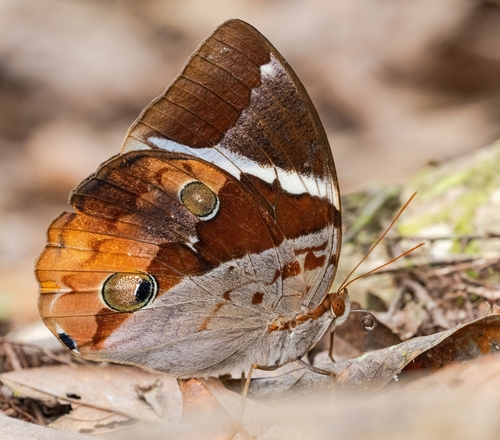
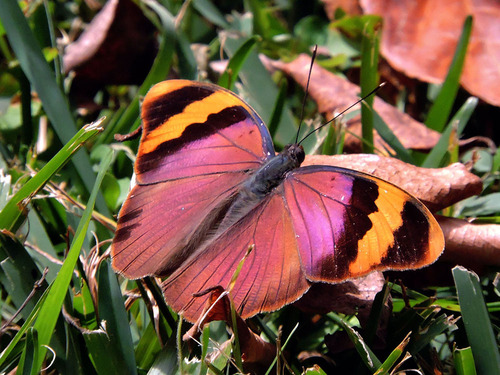
This species belongs to the Neophron Group, the members of which are easily recognizable by a shared color pattern: the upper surface of the hindwing and the basal portion of the forewing (extending to the start of vein 3) share the same color, while the apical portion of the forewing is black with a broad orange subapical band and a yellow apex. The underside of the wings is dark brown, grey-brown or yellowish, with 1 to 3 black dots in the cells, a median band ranging from lighter in males to whitish in females, and oval, not very distinct postdiscal spots. The forewing’s subapical band shows through faintly from the underside to the upperside. For the nominal subspecies E. neophron neophron (Hpffr.), the orange subapical band of the forewing reaches vein 2, or even extends slightly into cellule 1b; the basal part of the forewing and the entire upper surface of the hindwing are bright green or blue-green with a dark marginal band. According to Junod, the larva is green with two large golden yellow spots on each segment. This subspecies ranges from Delagoa Bay to Usambara. The subspecies violacea Btlr. is somewhat larger, and differs from the nominal subspecies in that the hindwing and basal forewing on the upperside are a beautiful violet, and the forewing’s subapical band does not reach vein 2; the underside is darker than that of neophron, especially in females. Its pupa is light green with golden spots. This subspecies is found in Kilimandjaro and British East Africa. E. ellenbecki Pag. completely matches the preceding forms in wing markings, but is smaller; the upperside of its hindwing and the basal portion of its forewing are brown-yellow, and only slightly darker than the forewing’s subapical band. It occurs in Abyssinia.