About Euphaedra medon (Linnaeus, 1763)
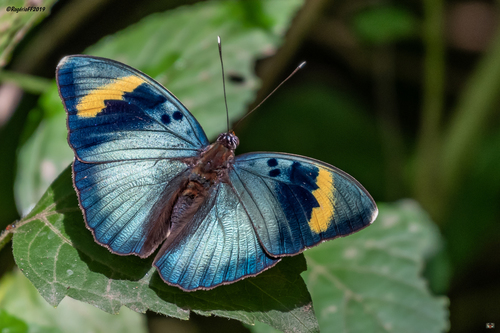
Euphaedra medon, originally described by Linnaeus in 1763, was the first known species of the genus Euphaedra. This species is quite variable in coloration, particularly in females, and shares similarities with some forms of the ceres species group. In males, the upper surface of both wings is glossy green or bluish, with a more or less broad blackish area along the distal margin. The forewing is broadly black inside the subapical band and has 2 or 3 black spots in the cell; its subapical band is broad and extends to vein 3. On the underside, both wings are green with a dark green submarginal band, 3 large black spots in the cell, and a white median band on the hindwing that is often broken into spots or even indistinct. The forewing apex has white fringes on the upper surface, but no white spot. Females are much larger than males, have a white apical spot on the forewing, and a very broad dark brown or blackish marginal band on the hindwing. The nominal form medon L. is defined as follows: in males, the upper surface of the hindwing is uniformly green or bluish, and the forewing subapical band is yellow, or light bluish with a green tinge; in females, the hindwing from almost the base to beyond the middle, and the forewing hindmargin, are bright blue-green or bluish, and the forewing subapical band is bright yellow. This form occurs from Sierra Leone to Angola. The female form agnes Btlr. differs from the nominal form in that the upper surfaces of the hindwing and forewing hindmargin are violet-brown, with a light blue or violet-blue median band approximately 7 mm broad; the forewing subapical band on the upper surface is yellow or white. This form ranges from Sierra Leone to Cameroons. The aberration viridinotata Btlr. has a large greenish yellow spot in the middle of the upper surface of the hindwing, within the green or bluish area. This aberration is found in Gaboon and Congo. The female aberration fernanda Fruhst. differs from viridinotata in having a larger white apical spot on the forewing and a much narrower yellow subapical band; its underside is darker than that of viridinotata, the white median band is more sharply defined, and the black submarginal band is much wider. This aberration occurs on Fernando Po. The aberration albula Thurau has a white subapical band on the upper surface of the forewing in both sexes, and a clay-yellow underside; in females, the upper surface is chocolate-brown with violet reflection, and the hindmarginal area of the forewing extending to vein 2, and the median area of the hindwing, are bluish violet. This aberration is found in Guinea. Thurauer described fraudata Thurau from a male specimen collected in Uganda, which is distinguished by a strikingly narrow forewing subapical band, measuring only about 2 mm broad at the costal margin and around 1 mm at the constriction on vein 4.