About Eupatorium altissimum L.
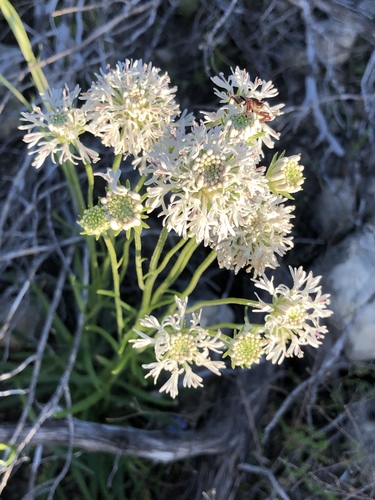
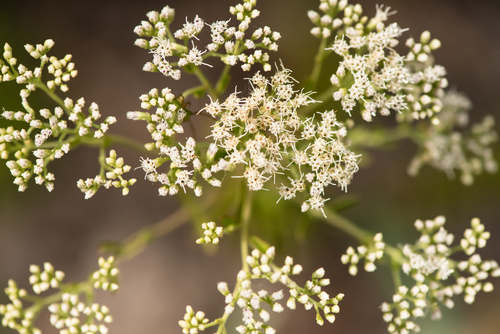
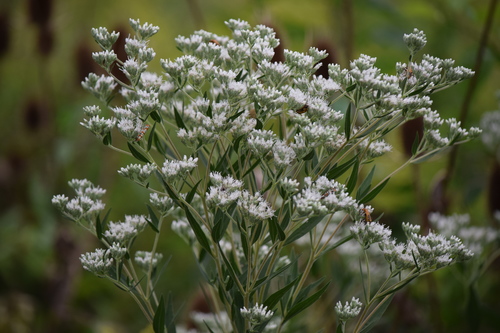
Eupatorium altissimum L. is a perennial herb that sometimes grows taller than 150 cm (5 feet). Its stems and leaves are covered in whitish hairs. Leaves grow in opposite arrangements along the stem, and are either sessile or have very short petioles. They are narrow, measuring 5–12 centimetres (2–5 inches) long and 8–30 millimetres (0.3–1.2 inches) wide. Leaves are lanceolate, with 3 prominent veins on their underside, and teeth only appear on the portion of the leaf above its middle. E. altissimum produces a large number of small, dull white flower heads arranged in a broad, flat-topped cluster at the top of the plant. Each flower head typically holds 5 disc florets and no ray florets. This species is often confused with Brickellia eupatorioides (false boneset), because the two plants have similar-looking flowers and both grow on limestone soils. They can be distinguished by leaf and flower traits: E. altissimum has opposite leaves with 3 prominent veins, while B. eupatorioides has alternate leaves with 1 prominent vein. Additionally, E. altissimum flower heads contain 5 florets, while B. eupatorioides flower heads hold 6 to 15 florets. E. altissimum is native to eastern and central North America, ranging north to Ontario, west to Nebraska, south to Texas and the Florida Panhandle, and east to Massachusetts. It almost always grows on limestone soils, found in prairies, open woods, fields, and neglected areas. The plant blooms from August to October. It attracts a variety of pollinators, acts as a larval host plant for Schinia trifascia (three-lined flower moth), and can hybridize with Eupatorium serotinum.