About Eumyias albicaudatus (Jerdon, 1840)
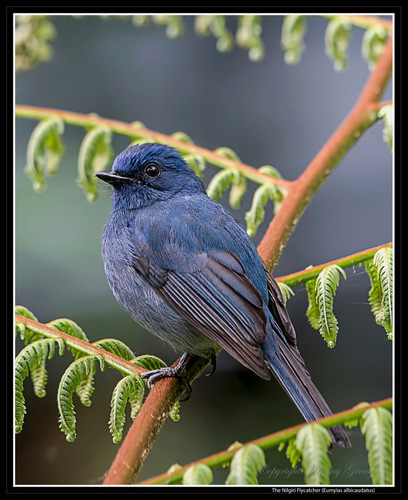
Identification: This small, somewhat long-tailed flycatcher measures about 13 cm (5.1 in). Adult males are dark steely indigo blue, with violet-blue coloring on the forehead and darker lores. It is much darker than the verditer flycatcher, and lacks the strong contrast between a pale face and black lores that the verditer flycatcher has. Females are duller in color, with dark brown upperparts and dark grey underparts. The two central tail feathers are blue, while lateral tail feathers are dark brown with indigo edges. The bases of the outer tail feathers are white, but this marking is not easily visible when the bird is perched. Wing feathers are dark brown, with a narrow blue fringe along the outer edge. Juveniles are dark brown with creamy spots, and have a scaly appearance on the throat and breast. This species has black bill and legs, and a dark brown iris. Distribution: This species is found in higher hills, mostly above 1200 m, of the Nilgiris, Palni Hills, Anaimalai Hills, the Brahmagiri, Bababudan Hills, and Biligiriranga Hills. Behaviour and ecology: Like most flycatchers, it makes short sallies from its perch to capture insects, then returns to the same perch. It forages mainly in the lower storey of forest, but can sometimes be found at the top of the canopy. Its song is a series of rich warbling notes, which resembles the call of the pied bushchat, while its usual call is a soft nasal chipping eep. The birds perch upright, and produce the chipping call while flicking their tail up and down. The breeding season runs from March to June, with peak egg-laying occurring in April. The nest is built in a cavity in an earth bank or a tree hole, and the species also uses the eaves of houses and wood-work of bridges for nesting sites. The nest is cup-shaped, with mosses and lichens on the outside and some feathers included, and it is not very well lined on the inside. The usual clutch is two to three eggs. The eggs are creamy brown, with dense mottling concentrated close to the broadest part of the egg.