About Eumorpha pandorus Hübner
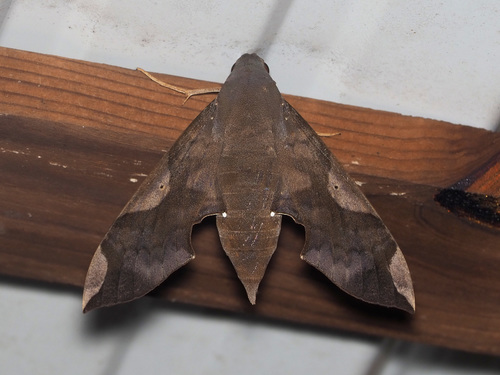
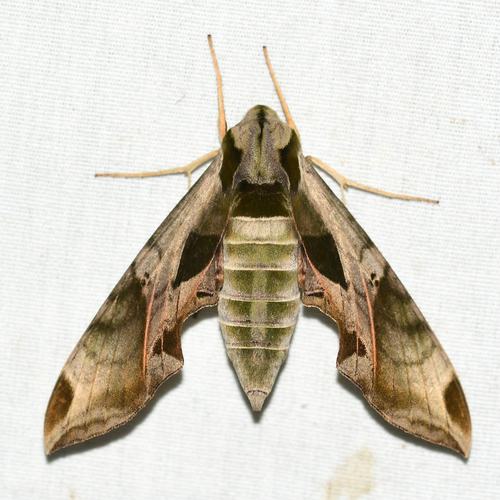
Eumorpha pandorus, commonly called the pandora sphinx moth, has a wingspan ranging from 3.25–4.6 inches, which equals 8.3–11.7 cm. Its wings are opaque, with a greenish-olive background on their dorsal surfaces. The wings are narrow, and are held in a triangular shape when the moth is at rest. Females generally have a larger abdomen than males. The dorsal side of the forewing has green markings, including a two-toned double spot that extends from the wing base along the forewing's inner margin. When the wings are folded, this spot aligns with a dark mark on the moth's body that covers each tegula. A green marking with a pale outline is visible near the apex of the forewing. When extended, the dorsal surfaces of the hindwings show black patches on a white background that becomes greenish-olive near the wing margins. Pink coloring appears around the tornus of each hindwing, and in scattered areas on the dorsal forewings. Both the forewings and hindwings have small dark eyespots located in the discal position; each eyespot has two tiny "pupils," and these spots remain visible even when the wings are folded. The ventral surfaces of the wings are a pale yellow-green or pale brown. E. pandorus shares the southern part of its range with E. intermedia. It can be told apart from E. intermedia by the shape of the darker section of its basal two-toned spot, on the end that faces the forewing's outer margin. In E. intermedia, this darker portion is strongly wing-shaped, because the spot's inferior border is shorter than its superior border. In contrast, the overall spot shape is more rectangular in E. pandorus. Additionally, the faint subterminal line on the forewing (located just basal to the apical spot) is typically scalloped in E. intermedia, but straight or slightly sinusoidal in E. pandorus. Caterpillars of this species grow up to 9 centimetres, or 3.5 inches, long. They are green in their first instar, but may be any of several colors in later instars, including green or brownish-red. The head and first two thoracic segments can be retracted into the third thoracic segment. The caterpillar abdomen has a small spot on the second segment, and large white oval spots that overlie the last five spiracles. Like other sphingid hornworms, they have a characteristic horn with its base on an eyespot at the abdominal end; however, only the raised eyespot is present in the final larval instar. This species is widespread in eastern, southeastern and central North America, ranging from Nova Scotia and Ontario to Florida and eastern Texas, and also occurs in the American Southwest.