About Eumedonia eumedon (Esper, 1780)
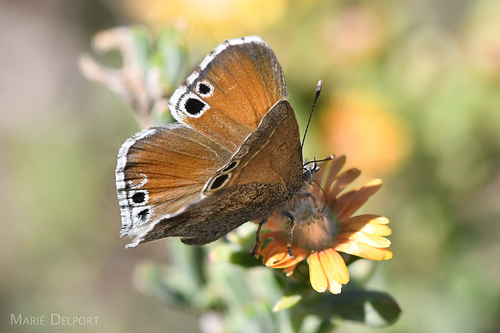
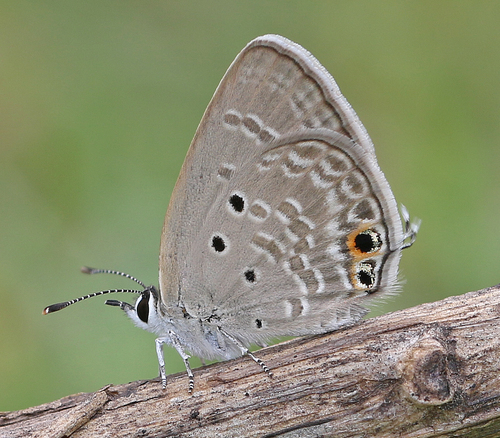
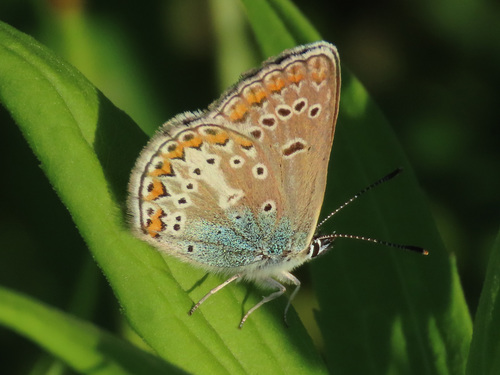
This description of Eumedonia eumedon (Esper, 1780), formerly referenced as L. eumedon Esp. and chiron Rott., is taken from Seitz. The upper side of the wings are dark brown with white fringes and a dark discocellular spot on the forewing. Females have small red anal submarginal spots on the hindwing, and sometimes also on the forewing. The underside of the wings is brown, with a red-yellow distal band that can be continuous or separated into spots; this band may appear only on the hindwing, extend to the forewing, or be entirely absent. The base of the wings on the underside is dusted with very glossy metallic scaling. The arrangement of ocelli is the same as it is in astrarche; typical specimens also have a distinct white streak running from the central spot of the hindwing to the outer margin. This species occurs across Europe, but only sporadically, usually in areas where Geranium grows. Its distribution extends from the Pyrenees to the Pacific Ocean and from Scandinavia to Italy, and it is absent from England. The larva develops inside the pods of Geranium. Adult butterflies are active from May to July, and until August in the high Alps. They fly rather slowly and clumsily, nearly always staying around Geranium flowers, and sleep through the night in the plant's blossoms. During flight, they move their wings very regularly up and down, and often remain fluttering in the air in front of a flower before settling on it. Males and females are equally common, and they appear to leave their flight sites unwillingly. Pairs in copula are often encountered at these sites. In the Alps, this species is found relatively much more rarely at roadside rills than other less abundant butterfly species.