About Eulychnia iquiquensis (K.Schum.) Britton & Rose
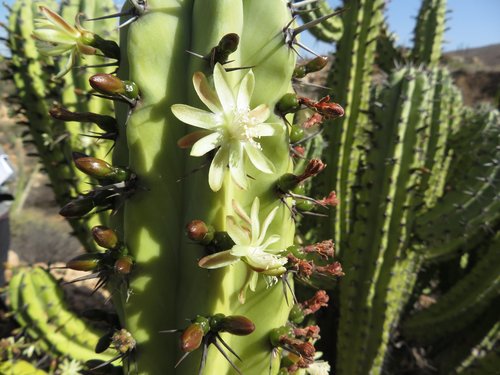
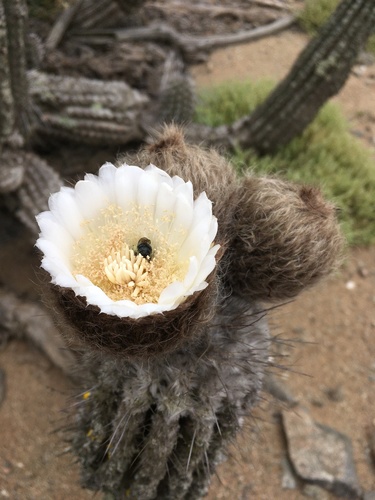
This tree-like cactus, Eulychnia iquiquensis, typically grows 2 to 4 meters tall, occasionally reaching 7 meters, and features a short trunk with an erect growth habit. It begins branching around 1.5 meters above ground, with most branching starting from the base, forming steep upright branches. Its shoots are dark greenish-gray, and measure 7 to 10 cm in diameter. Stems have 12 to 13 ribs, sometimes 14; 10 or 11 ribs occur less commonly. These ribs are about 2 cm high, with flat, parallel sides and notches separated by narrow grooves. Areoles are approximately 8 mm in diameter; they start covered in brown felt that quickly turns grayish. They sit on the upper flank of tubercles, extend into the upper notch, and are spaced 4 to 8 mm apart. Each areole produces 10 to 20 spines, with no clear difference between central and radial types, and all spines are generally straight. Shorter, needle-shaped spines grow to about 1 cm or less. Among the spines, 2 to 4 notably longer, more robust central spines measure 3 to 10 cm; they start black and turn grayish as they age. Thinner spines have yellowish or brownish coloring. In taller specimens, spines become more bristly and spread outward, and areoles grow closer together. Flowers grow at or slightly below the stem tip, open only during the day, and are either odorless or faintly fragrant. They are 5.5 to 6.5 cm long, with an opening 5 to 6 cm across. Petals are white; outer petals, and to a lesser degree inner petals, have fine reddish-brown tips. Petals are 2 to 2.5 cm long and about 5 mm wide, with a short apex that can be pointed or rounded, and are widest near the tip. Only the lower third of the petal surface is covered by woolly hairs on the outside, and by anthers on the inside; petals stay erect. The ovary is nearly round, about 2.5 to 3 cm long, with a similar thickness at its upper portion. It is covered in dense, narrow greenish scales with brownish tips and long, white woolly hairs, which are occasionally light yellow or yellowish-brown. The ovary wall is about 8 mm thick. A honey-yellow nectary 1 to 1.5 mm high forms a ring around the base of the style. The floral tube is bowl-shaped, about 1.5 cm long and 2.8 to almost 4 cm wide; its exterior matches that of the ovary, and is covered in hairs 2 to 3 cm long. Numerous white stamens 1 to 1.5 cm long are present; upper stamens are shorter and erect, while lower stamens lean toward the style. Cream-colored anthers are mostly all at the same height, around the middle of the petals, and are distributed along the floral tube. The pollen is light yellow. The white, robust style is about 6 mm thick at its base, tapering to 3 to 5 mm at the top, and is approximately 2 cm long. This length includes 7 to 10 mm of 27 to 35 spreading, pale yellow stigmatic lobes that usually reach or extend past the anthers. The fruit is nearly spherical and green, measuring 6 to 8.5 cm long and 5 to 6.5 cm in diameter. It is covered in dense white wool like the ovary, and contains juicy, acidic pulp that is white or pinkish. Black seeds are approximately 1.7 mm long, 1.0 mm wide, and 0.5 mm thick, with a slight grayish coating and a matte surface. They have a pointed basal apex and a subtle dorsal keel. The seed coat has fine, indistinct small bumps, and occasionally has faint dorsal transverse ribs. An oblong, whitish hilum is located on the ventral to subventral side. Eulychnia iquiquensis is native to a narrow coastal strip in northern Chile, specifically the Tarapacá, Antofagasta, and Atacama regions. This species grows in desert and dry scrub biomes, ranging from near sea level up to around 1100 meters in altitude. It grows primarily on coastal hills influenced by camanchaca fog, which is the key source of moisture in this arid region with very little rainfall. Eulychnia iquiquensis is easily recognized by its size and visibility. It is the only woody plant that occurs regularly in these coastal environments, and does not extend into the inland pampa.