About Eulychnia chorosensis P.Klaassen
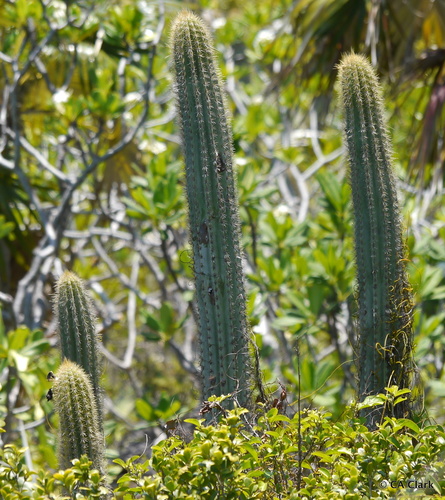
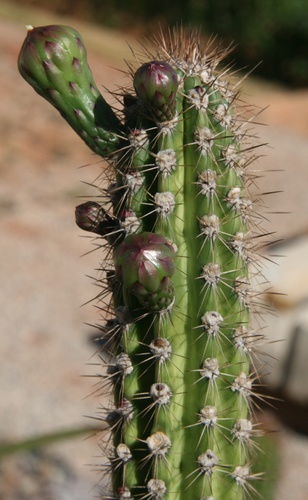
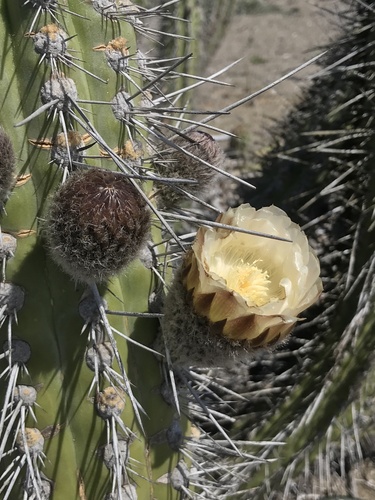
Eulychnia chorosensis is a shrubby cactus that grows as a prostrate clump. It reaches up to 3 meters wide, no more than 1 meter tall, and has upward-pointing stem tips. Its grayish-green stems grow up to 2 meters long, with a diameter of 5 to 8 cm. Stems have 8 to 13 rounded ribs roughly 1.5 cm wide and 5 to 8 mm deep, and sometimes have a shallow groove above the areoles. The large, rounded areoles are about 1 cm in diameter, spaced 7 to 10 mm apart, and covered in light gray or white felt. Its spines include 1 to 3 very long, straight, forward-pointing central spines that measure 4 to 15 cm. It also has up to 12 short radial spines of unequal length, ranging from 1 to 3 cm; sometimes few or no radial spines are present. The fragrance-free, diurnal flowers are 6.5 to 7 cm long and 4 to 6 cm wide, and grow along the upper stem, not only at the apex. The floral tube is noticeably thick and green, made up of large, mucilage-filled cells. It has numerous green scales partially hidden by dense, dark brown wool, and its inner area around the ovary is white. The white petals, sometimes with a faint pink central stripe, are 1.5 to 2 cm long and 8 to 14 mm wide, with rounded tips. The thick, white style is about 2 cm long and carries 15 to 20 yellowish stigmatic lobes. Numerous white stamens with pale yellow anthers completely fill the open flower. The globose fruit is roughly 5 cm in diameter. It shifts from green to brownish-green when it ripens, and retains its scales and dark brown wool. The fruit has a thick wall with large, colorless mucilage-filled cells, which surround a white, translucent, acidic pulp that holds numerous seeds. These seeds are brownish-black with a matte surface, measuring about 2 mm long, 1.2 mm wide, and 0.5 mm thick. Eulychnia chorosensis is closely related to Eulychnia acida, and shares traits such as large, felt-covered white areoles, robust spination, and flower placement along the stem. However, Eulychnia chorosensis can be distinguished by its consistently dense, dark brown wool covering the floral tube, a trait not typically seen in Eulychnia acida, and generally has a smaller overall individual size. Seedlings of the two species are morphologically similar and hard to tell apart in early growth stages. This species is native to a restricted coastal strip in northern Chile, where it grows mostly on the sandy Llano de Choros plain between the Coquimbo and Atacama regions. It grows in low-lying clumps, adapted to the area’s windswept environment. Its range also extends, less commonly, to the hills north and east of this plain, and it has been observed as far south as the Huasco River. The species also grows well on Chañaral and Damas Islands. On these islands, its sprawling stems provide critical shelter for Humboldt penguin burrows, demonstrating its ecological importance in coastal habitats. It lives primarily in desert and dry scrub ecosystems. It is found at lower altitudes, but can also grow up to 1000 meters above sea level, showing its adaptability within its narrow coastal distribution.