About Eulychnia breviflora Phil.
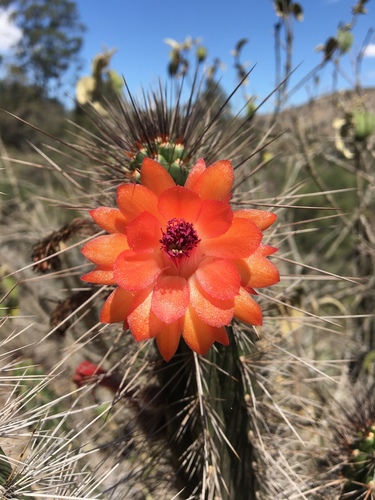
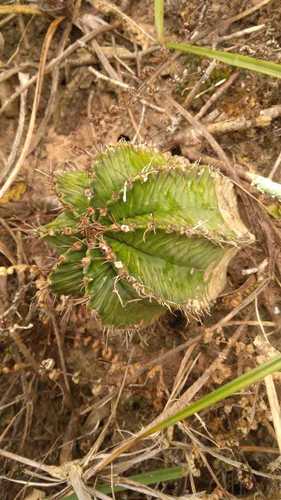
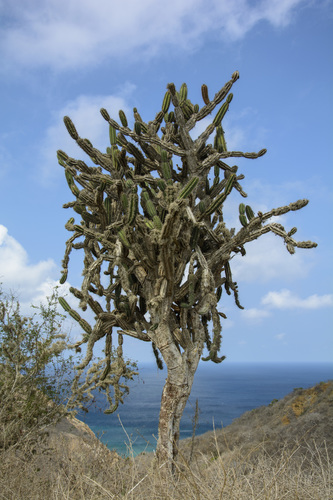
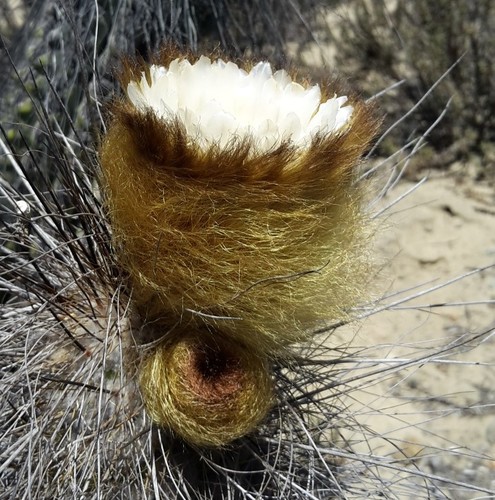
Eulychnia breviflora Phil. is a columnar cactus species with a tree-like growth habit. It typically reaches 2 to 3 meters in height, though it only grows to 1 to 2 meters in some locations. It grows upright, sometimes with a slight lean at its base, and has a grass-green or grayish-green epidermis. It branches abundantly from its base up to roughly half the plant's total height, producing erect branches that bear shoots 6 to 10 cm (2.4 to 3.9 in) thick. The stem has 10 to 13 blunt, toothed ribs that measure 8 to 15 mm (0.31 to 0.59 in) in both height and width. These ribs are separated by narrow, slightly wavy grooves. Rounded areoles 7 to 10 mm (0.28 to 0.39 in) in diameter are covered in short brownish-black felt that darkens to gray as they age; young plants have lighter-colored areole felt. These areoles sit on the upper section of the tubercles, extending into the indentations, and are spaced 1 to 1.5 cm (0.39 to 0.59 in) apart. The spines of Eulychnia breviflora are dark brown and turn gray over time; they are straight and needle-like, and occasionally slightly curved. Even the longer central spines are sharp with no blackening at their tips. There are 10 to 22 radial spines, which usually differ in length, ranging from a few millimeters to around 3 cm (1.2 in). In young plants, radial spines grow more laterally; as the plant ages, the radial spines become more spread out and thinner. The 3 to 6 central spines are not clearly distinct from radial spines, usually only one or two of them reach 5 to 15 cm (2.0 to 5.9 in) in length, while the remaining central spines are short. On upper shoots, all spines become thinner and arranged in a broom-like pattern, with the longer central spines resembling bristles or fine hairs. In this upper shoot arrangement, the areoles are smaller and positioned closer together. Flowers grow near the apex of older stems, are odorless, and open to a diameter of 5 to 6 cm (2.0 to 2.4 in), with a total length of 7 to 8 cm (2.8 to 3.1 in). The ovary makes up approximately half of the flower's total length. The top-shaped ovary is around 3 cm (1.2 in) in diameter, densely covered in narrow green scales. Its areoles bear brownish-black felt and abundant long, curly golden-yellow wool that completely covers the ovary. A reduced nectary ring forms a hollow ring approximately 1 mm (0.039 in) high around the base of the style. The floral tube is over 2 cm (0.79 in) long and around 1.5 cm (0.59 in) wide at the top, is cup-shaped, and has the same external covering as the ovary. White stamens are inserted into the lower half of the floral tube and at the tube's rim. The style is roughly 2.5 cm (0.98 in) long and 6 to 7 mm (0.24 to 0.28 in) thick, with approximately half of its length made up of around 25 pale yellow stigmatic lobes. The petals are white, often pinkish near the top with brownish tips, around 2.5 cm (0.98 in) long and 1.5 cm (0.59 in) wide, with blunt to slightly pointed tips. The fruit is roughly spherical, green, around 6 cm (2.4 in) in diameter, and has the same covering as the ovary. Its pulp is white, acidic, and fills the fruit completely. The seeds are approximately 2 mm (0.079 in) long, 1.2 mm (0.047 in) wide, and 0.5 mm (0.020 in) thick. They appear black or covered in a brown coating, are matte, very convex on the dorsal side, somewhat keeled, pointed at the base, and nearly smooth or very finely granular. A narrow, white, slightly sunken hilum is located on the ventral side of the seed. Eulychnia breviflora is native to northern Chile, ranging from the western Atacama region to the northwest of the Coquimbo region, growing primarily along the coastal strip. It inhabits desert and dry scrub biomes from sea level to approximately 400 meters elevation, growing on coastal hills, slopes, or in thorny scrub on sandy soils in arid, sparsely vegetated environments. It is highly tolerant of drought, and its low rainfall input is supplemented by frequent coastal fogs that often form a consistent daily cloud band. This added humidity can lead to lichen growth on specimens growing along the coast. The species' coastal range overlaps with the range of Eulychnia acida, and natural hybridization between the two species has been observed.