About Eulychnia acida Phil.
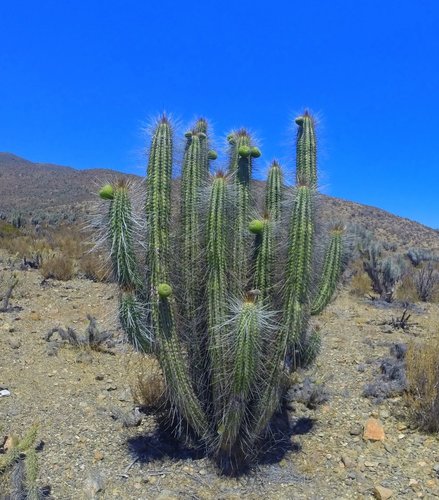
Eulychnia acida Phil. is an arborescent columnar cactus that usually grows in a tree-like form, reaching 1.5 to 4 meters tall, and can grow up to 7 meters tall under favorable conditions. It typically develops a distinct trunk around one meter long, branching out from the trunk to form a rounded crown. Alternatively, some individuals do not have a clear trunk, and grow as low, heavily branched plants that are often prostrate or ascending, rarely growing over one meter tall. Growth is often irregular and asymmetrical due to the species' struggle for moisture, resulting in a disordered overall appearance. Stems may be erect or nearly prostrate, measure 6 to 12 cm (2.4 to 4.7 in) in diameter, and are heavily spined even at the seedling stage. The greenish-gray epidermis is often covered in accumulated dirt and dust. It is common to see dead or dying tissues next to inactive living tissue, which makes it difficult to distinguish active growing areas from dormant ones. Stems have 10 to 16 broad, low ribs, with areoles spaced 7 to 15 mm (0.28 to 0.59 in) apart along the ribs. Spination is highly variable, made up of nearly straight, erect, needle-shaped spines that are dark brown when young and turn gray as they age. Each areole usually holds one to two central spines, which are erect and unusually long, measuring 10 to 20 cm (7.9 in), alongside around 12 radial spines that point outwards and are roughly 1 cm (0.39 in) long. Flowers grow near the tips of stems and are broadly bell-shaped, measuring 5 to 7 cm (2.0 to 2.8 in) long and 4 to 6 cm (1.6 to 2.4 in) in diameter at the opening. Flowers are white, sometimes with a pale pink central stripe. The ovary and floral tube are covered in small, ovate, overlapping scales that are fleshy at the base and tipped with sharp, calloused black points, and decorated with very short tufts of dark blue to blackish-gray hairs. The inner perianth segments are 2 to 2.2 cm (0.79 to 0.87 in) long; they are pale pink at first, and later turn white with a pink stripe. The flower throat is very short and densely packed with enclosed stamens that are 1 to 1.5 cm (0.39 to 0.59 in) long, arranged within the wide, white throat. The style is short, sturdy, around 2 cm (0.79 in) long, rigid, and white, with 12 to 15 stigmatic lobes. The fruit is globose, 5 to 6 cm (2.0 to 2.4 in) long and around 5 cm (2.0 in) in diameter. It is scaly, hairy, and spineless, with fleshy, somewhat acidic pulp. Immature fruit is greenish-gray, and ripens to a brownish-yellowish green, and is topped by persistent floral remnants. The edible fruit is nearly bare, with no wool or spines, and contains dull black seeds around 1.5 mm (0.059 in) long. Seeds are dispersed by Mimus thenca. Eulychnia acida is native to northern and central Chile, occurring from north of Vallenar to south of Illapel in desert and dry scrub biomes, ranging from sea level up to around 1300 meters in altitude. It grows well in coastal valleys and mountain slopes, often growing alongside other cactus species such as Leucostele chiloensis, and prefers rocky, fog-exposed areas where condensation supplies moisture to its root system. While it can also be found on gentler slopes and plains with very little water, its occurrence in these habitats, where annual rainfall rarely exceeds 50 mm, demonstrates its remarkable adaptation to extreme aridity. This species is an important component of its native scrubland ecosystems, and shows substantial morphological variation shaped by both genetic factors and local environmental conditions. Eulychnia acida can live very long lives, with some individuals surviving for centuries, and plays an important ecological role in the Huasco and Aconcagua valleys. It also participates in a highly specialized ecological interaction: it is the only host parasitized by the hemiparasitic plant Tristerix aphyllus.