About Eulaema meriana (Olivier, 1789)
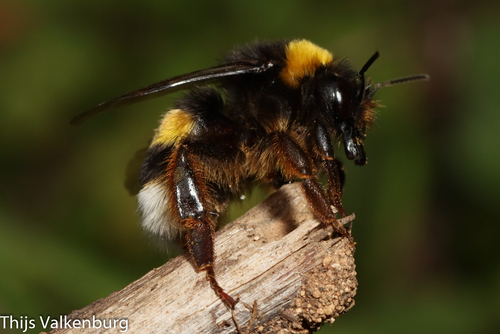
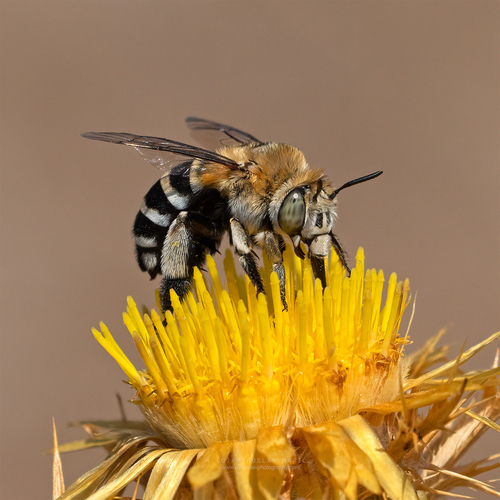
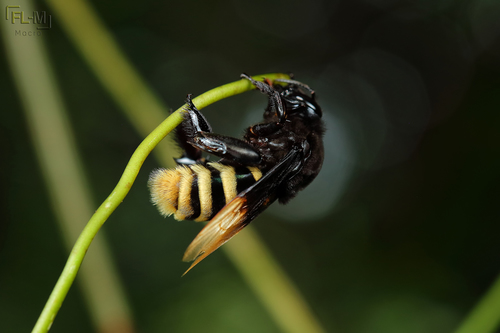
Eulaema meriana (Olivier, 1789) resembles a bumblebee in appearance, and is covered in short, dense hairs. At first glance, Eulaema bees look like large bumblebee queens. They are relatively large bees with faint metallic coloration. The head of E. meriana is black, the thorax is brownish black, and it has a large, glossy black scutellum. Their abdomen is black with three transverse pale yellowish bands on the anterior half, while the posterior third is reddish brown. This species also has membranous wings that are dark at the base and paler at the tips. The legs are black, and the tibia of the hind legs are much thicker than other segments. Males have hollows on their hind legs, while females have pollen baskets. In general, the species has long tongues thought to be an evolutionary adaptation that aids nectar collection. Its large body size is thought to allow the bees to fly in cooler, rainy conditions and continue foraging, and it has also been suggested that larger body size can help them forage over longer distances. Eulaema meriana is native to Panama, Colombia, Venezuela, the Guianas, Ecuador, Peru, Bolivia and Brazil. It is found in forests of the Amazon basin, but is replaced in Atlantic coastal forest by Eulaema niveofasciata and Eulaema flavescens. The genus Eulaema as a whole ranges from Mexico to northern Argentina. Like other orchid bee species, both male and female E. meriana visit flowers to feed on nectar. Beyond feeding, males have a mutualistic relationship with one or more orchid species. To attract male E. meriana to its flowers, the orchid produces a fragrance with a specific chemical composition that appeals to this exact bee species, which is the right size and shape to pollinate the flower. Stanhopea orchids are mostly pollinated by large Eulaema bees, as Euglossa species are often too small for this task. In more primitive species of the Eulaema genus, the orchid pollinium (a packet of pollen) sticks to the male bee as it backs out of the flower after collecting the fragrance. In more advanced Eulaema species, a fall-through mechanism occurs: the bee loses its footing on oil droplets while collecting fragrance, and the pollinium sticks to the bee as it slides out of the flower. E. meriana has been observed visiting Stanhopea florida and pollinating Stanhopea candida, Stanhopea costaricensis, and Stanhopea tricornis. It also pollinates Catasetum macrocarpum and Notylia pentachne. It is the only bee species so far reliably documented as a pollinator of the orchid Vanilla grandiflora. In one study that identified which insects pollinate the flowers of the Brazil nut tree (Bertholletia excelsa), researchers found that the flowers are visited by many bee species, including E. meriana, which visits early in the day. Both males and females were observed collecting nectar from the base of the flower's lower lip. The study concluded that E. meriana contributes to the pollination of Brazil nut flowers, but two other bee species, Eulaema mocsaryi and Xylocopa frontalis, are more important, meaning E. meriana is not required to pollinate Brazil nut flowers. Even so, successful pollination in commercial Brazil nut plantations depends on the plantation being surrounded by intact primary forest with its epiphytic orchid population, to supply enough pollinating bees for the large number of flowers.