About Eugnorisma glareosa Esper, 1788
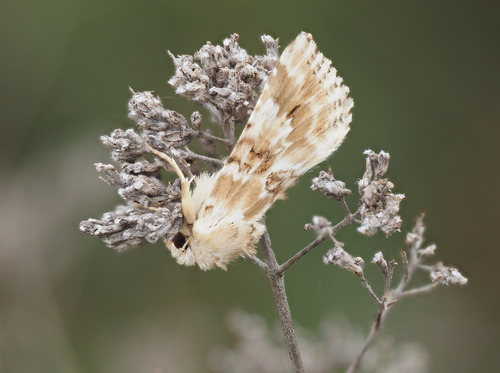
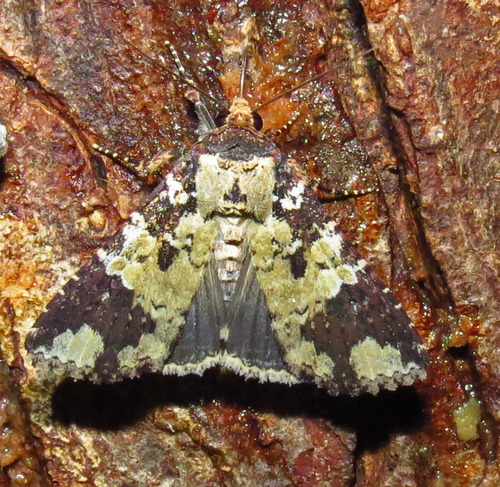
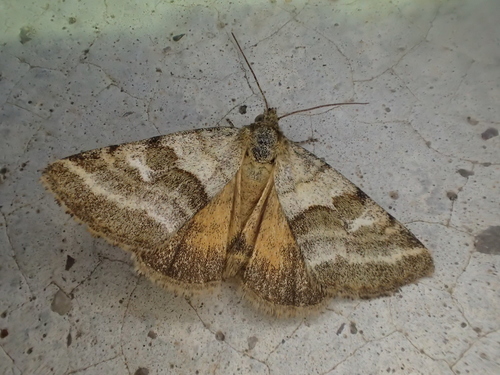
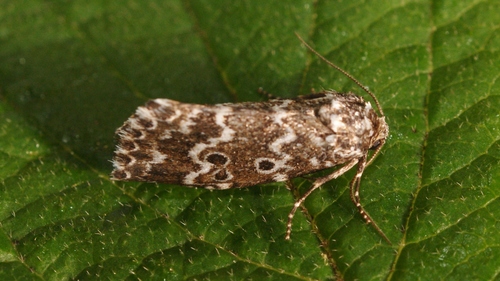
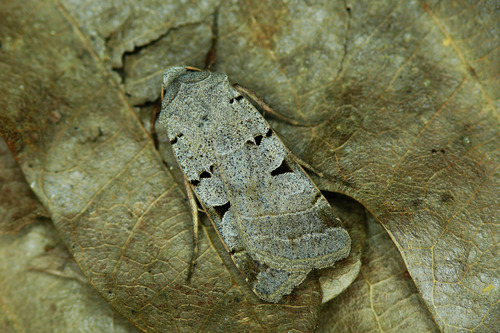
This species is scientifically known as Eugnorisma glareosa Esper, 1788. Its forewings are most commonly pale grey, with a distinct pattern of a row of three angular black marks. The base ground colour of the forewings is quite variable, with pinkish or reddish colour forms occurring fairly frequently. An almost black form is found in the north of Scotland, including Orkney and Shetland; some authorities treat this dark form as a subspecies, E. g. edda. Typical forms have white hindwings, while darker colour forms have grey hindwings. The total wingspan of this moth ranges from 32 to 38 mm. In technical terms, the forewing is pearly grey with fine dark dusting. The areas of the cell before and beyond the orbicular stigma are velvety black brown. The subbasal and inner lines are each marked by a black spot on the costa, and a second black spot below the median vein. The outer and submarginal lines are pale. The hindwing is whitish with grey dusting, and this dusting is more prominent in females. Named colour variants include the dark form edda Stgr. from the Shetland Islands, which has red brown forewings and dark brown hindwings; rosea Tutt, which is lilac grey suffused with rosy colour; and limbata Gouin from Gironde, France, which has forewings tinged with bluish green, and a darker marginal area than is typical for the species. Eugnorisma glareosa has an Atlantic-Mediterranean distribution. It can be found from Morocco and the Iberian Peninsula, through western and central Europe, to the British Isles, southern Norway, southern Sweden, Poland and Estonia. It has expanded its range eastward over the last century.