About Eugenia uniflora L.
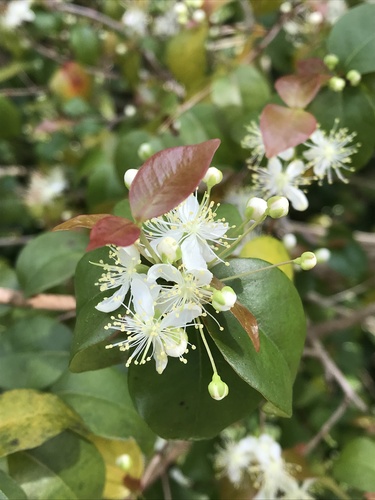
Eugenia uniflora L. is a slow-growing large shrub or small tree with a conical growth form, reaching up to 8 metres (26 ft) in height. When leaves or branches are bruised, crushed, or cut, they release a spicy, resinous fragrance that can cause respiratory discomfort for susceptible people. Its leaves are unstipuled, ovate, glossy, and arranged in opposite pairs. New growth leaves are bronze, copper, or coppery-pink, and mature to a deep glossy green, reaching up to 4 centimetres (1+1⁄2 in) long; leaves turn red during winter. The flowers have four white petals, grow on long, slender stalks, and feature a prominent central cluster of white stamens tipped with yellow anthers. After flowering, the plant produces ribbed fruits 2 to 4 centimetres (3⁄4 to 1+1⁄2 in) long. Fruits start green, then change through orange, scarlet, and maroon as they ripen. Since fruit-eating birds disperse its seeds, Eugenia uniflora can become an invasive weed in suitable tropical and subtropical habitats, where it displaces native flora. The edible fruit of Eugenia uniflora is a botanical berry. Its taste ranges from sweet to sour, depending on cultivar and ripeness: darker red to black ripe fruits are quite sweet, while green to orange unripe fruits are distinctly tart. Its main culinary use is as a flavoring and base for jams and jellies. The fruit is high in vitamin C and a source of provitamin A. In some parts of Uruguay, the leaves are used to make tea. In Brazil, leaves are spread across the floors of some houses; when crushed underfoot, they release a scent that repels flies. Eugenia uniflora has multiple notable pharmacological properties. Its essential oil is antihypertensive, antidiabetic, antitumor, and analgesic, and has demonstrated antiviral and antifungal activity. It has shown activity against microorganisms including Trichomonas gallinae (studied in vitro), Trypanosoma cruzi, and Leishmania amazonensis.