About Eudonia truncicolella (Stainton, 1849)
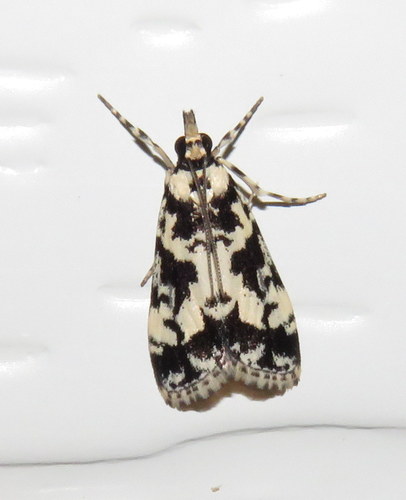
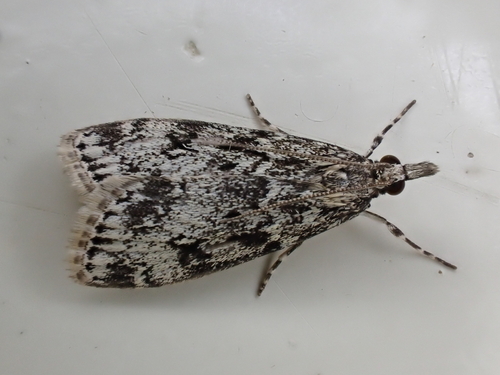
Eudonia truncicolella is a moth species in the Crambidae family, first described by Henry Tibbats Stainton in 1849. Its range extends from China (Hebei, Heilongjiang, Inner Mongolia, Jiangsu, Jilin, Liaoning) and Japan westward into Europe. This moth has a wingspan of 18–23 mm (0.71–0.91 in). The forewings are ochreous-whitish, heavily sprinkled with black; the base has blackish markings. The forewing lines are whitish with dark edges: the first line is irregular, and the second is angulate-sinuate and subserrate. The orbicular and claviform markings are either dot-like or somewhat elongated, and black. The discal spot is 8-shaped and outlined in black. The subterminal line is whitish, and touches the second line at the middle. The hindwings are whitish-grey, and grow darker toward the terminal edge. Full-grown larvae are dull dark brown, with a blackish dorsal line, black spots, and a dark brown head. The sclerotized plate on the second segment is almost black. Adult moths fly from June to October, with flight timing varying by location. The larvae feed on a wide variety of mosses.