About Eudonia lacustrata Panzer, 1804
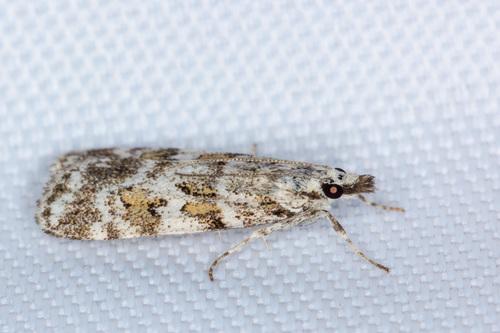
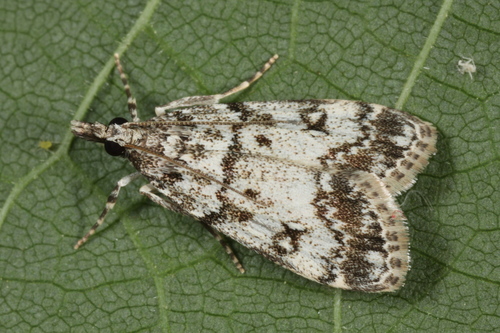
Eudonia lacustrata, a species of moth in the Crambidae family, was described by Georg Wolfgang Franz Panzer in 1804. This species can be found in Europe, north-west Africa, and across Asia ranging from Turkey, Iran, and Syria to Siberia and western Hunan, China. The subspecies E. lacustrata persica occurs in Iran and Armenia. The wingspan of Eudonia lacustrata measures 16–18 mm, or 0.63–0.71 inches. The forewings are whitish, sometimes mixed with light ochreous-yellowish tones, and sprinkled with black. There is a black marking at the base of the forewing. The forewing lines are whitish with blackish edges: the first line is irregular, and the second is rather sinuate. The orbicular and claviform markings are small, dot-like, and black, with an additional black X-shaped discal mark. The terminal area of the forewing is grey mixed with black, and the interrupted white subterminal line is interrupted in its middle. The hindwings are whitish-grey and grow darker toward the terminal edge. Full-grown larvae are yellowish-green, with brownish-green spots and black-brown heads and second thoracic segment plate. Larvae live on mosses. Adult moths fly from May to August, with timing varying by location. The larvae feed on a variety of different mosses.