About Eudonia dinodes Meyrick
Hudson described the larva of Eudonia dinodes Meyrick as follows: The larva, which feeds on mosses during winter and early spring, reaches about 1⁄2 inch in length, is cylindrical, and tapers slightly at both ends. Its head and the dorsal plate of the second segment are a very deep bronzy-black, slightly tinged with green and highly polished. The rest of the body is pale bronzy-brown with a yellowish-green tinge. There are four rows of large, highly polished bronzy-greenish-black tubercles; each segment in the two sub-dorsal rows has one large and one small tubercle, and a stout black bristle grows from each tubercle.
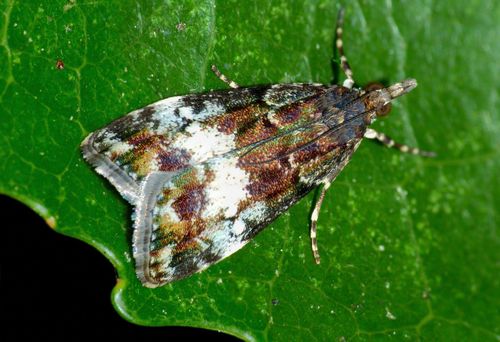
Meyrick described the male adult of this species as follows: Male. Wingspan 17 mm. Head and thorax are rather dark fuscous, mixed somewhat with whitish. Palpi are length 2, dark grey, with a white basal joint. Antennae are dark fuscous, with ciliations of 1⁄4. Abdomen is whitish-grey. Legs are white, with tibiae and tarsi banded with black. Forewings are triangular, with a gently arched costa, rounded apex, and a nearly straight, oblique hindmargin; they are white, densely speckled with dark fuscous, and the basal area has suffused black spots. The first line is barely whitish, very obscure, black-margined on the posterior side, curved, and barely indented. The orbicular and claviform spots are small, roundish, obscure, black, and detached. There is a rather broad clear white transverse space before the second line, of even width except on the inner margin where it is contracted. The reniform spot is included in this space, is 8-shaped, white, and black-margined. The second line is slender, obscure, white, dark-margined on the anterior side, somewhat curved, and barely sinuate. The subterminal line is narrow, white, distinct, interrupted above the middle, and does not touch the second line. There is a row of white spots along the hindmargin, and the cilia are grey with a dark grey line. Hindwings are 1+1⁄4, whitish-grey, with the lunule and postmedian line obscurely visible, and a darker grey hindmargin; cilia are whitish with a dark grey line.
This species is similar in appearance to Eudonia minualis and Eudonia minusculalis, but can be distinguished by its remarkably short antennal ciliations and the lack of an ochreous blotch on the forewings. Hudson noted that this species differs from E. minualis by the absence of a yellow blotch near the termen and by its clear white 8-shaped reniform, and differs from Eudonia minusculalis by its much smaller and more broken white markings.
This species is endemic to New Zealand. It has been observed on the North Island, South Island, Stewart Island, and Chatham Islands. It inhabits native forest.