About Eudonia chlamydota Meyrick
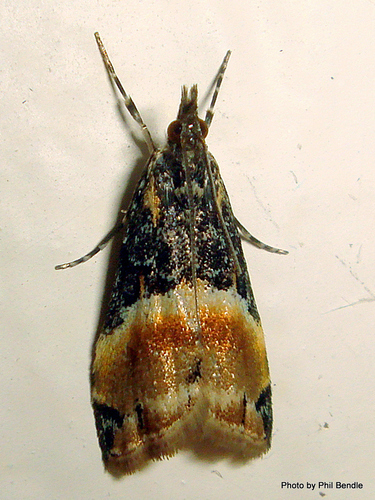
Meyrick originally described Eudonia chlamydota as follows: Both males and females have a wingspan of 13–14 mm. The head, palpi, and thorax are whitish-ochreous, suffused with black; the palpi measure 2 units in length. The antennae are greyish-ochreous, with ciliations measuring 1⁄2 unit in length. The abdomen is ochreous-whitish. The legs are ochreous-white, with tibiae and tarsi banded with dark fuscous. The forewings are triangular, with a slightly arched costa, a rounded apex, and a straight, oblique hindmargin; they are colored ochreous-whitish. Their basal half, which is bordered by a line running parallel to the hindmargin, is suffused with blackish color, except for an oval ochreous spot near the middle of the wing base. A moderately broad, fascia-shaped reddish-ochreous suffusion sits just beyond the posterior edge of the blackish patch, and runs parallel to it. An irregular reddish-ochreous suffusion occurs toward the middle of the hindmargin. A rather small triangular blackish spot is located on the costa before the apex, and some blackish scales are present on the anal angle. The forewing cilia are ochreous-whitish, mixed with reddish ochreous in the lower section and blackish above the apex. The hindwings measure 1+1⁄4 units, and are whitish; the postmedian line and apical suffusion are faintly grey; the hindwing cilia are whitish. Adult individuals of this species vary in the depth of wing coloration. This species is endemic to New Zealand, where it occurs in both the North and South Islands. It inhabits native forest at altitudes up to around 3000 ft. Adults have been observed frequenting Hoheria lyallii at forest edges near rivers. Larvae feed on moss species, and build a silk shelter at the base of the host plant. Larvae pupate inside a cocoon located within their host plant.