About Eudonia atmogramma Meyrick, 1915
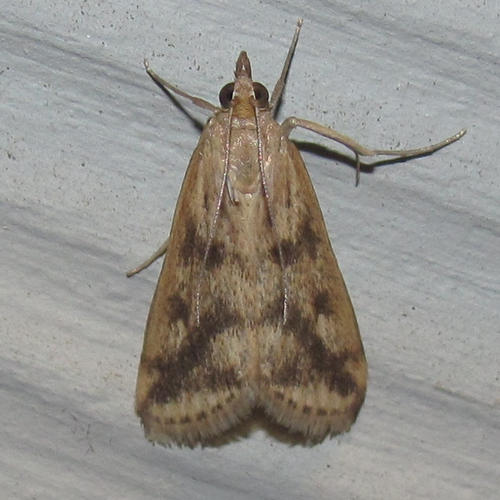
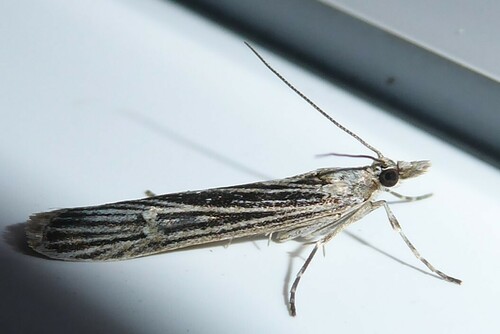
Meyrick's original description of this species reads as follows: Male specimens have a wingspan of 23–24 mm. The head and thorax are light grey, more or less mixed with whitish scales. The palpi are 3 times the length of the head, light grey, and white towards the base on the underside. Antennal ciliations are two-thirds the length of the antenna diameter. The abdomen is pale greyish-ochreous. The forewings are elongate, very narrow near the base, gradually widen towards the back, with an obtuse apex, and a slightly rounded, rather oblique termen; they are ochreous-grey, usually more or less suffused with whitish along the veins, and the spaces between the veins are more or less suffusedly sprinkled with dark fuscous. The claviform stigma is marked by a small spot of dark fuscous suffusion; the forewing cilia are white, with a grey line. The hindwings have a width to length ratio of 1+1⁄4, and have no long hairs in the cell; they are light grey, paler towards the base; the hindwing cilia are white, or whitish-ochreous in one specimen, with a faint grey line. This species looks similar to forms of Eudonia paltomacha, and can also be confused with a form of Eudonia leptalea. This species is endemic to New Zealand, and has been observed on the South Island and Stewart Island. It has been recorded in a range of habitats, including saline wetlands, salt pans, and granite sand plains.