About Eudonia asterisca Meyrick
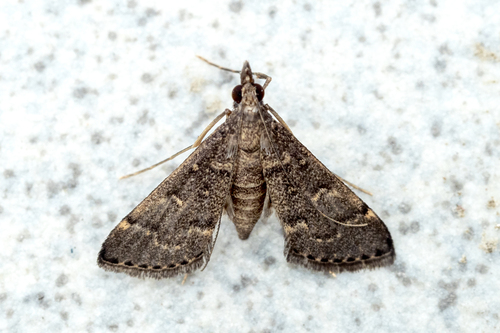
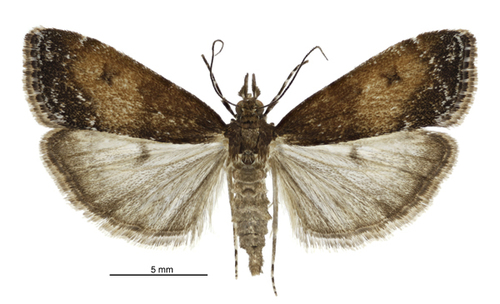
Eudonia asterisca was originally described by Meyrick. Both males and females of this species have a wingspan between 21 and 23 mm. The head and thorax are fuscous, and suffused with dark fuscous. The palpi measure 2 and 1/4, are dark fuscous, and have a white basal joint. The antennae are fuscous, with ciliations measuring 1/2. The abdomen is whitish-grey. The legs are whitish and irrorated with dark fuscous, with tibiae and tarsi banded with black. The forewings are rather elongate and triangular, with a barely arched costa, rounded apex, and an almost straight, rather oblique hindmargin. They are a dull ochreous-fuscous, with basal and terminal areas suffused with dark greyish-fuscous. The first line, orbicular, and claviform are all obsolete, and merged into the basal suffusion. The reniform is x-shaped, suffused, and dark fuscous. The second line is slender, whitish, dark-margined, and moderately curved. The subterminal is slender, whitish, and does not touch the second line. The cilia are whitish, with a dark greyish-fuscous basal third and posterior line. The hindwings measure 1 and 2/5, and are ochreous-grey-whitish, with a distinct, dark grey lunule. The hindmargin is narrowly suffused with dark grey, and the cilia are white with a dark grey line. This species varies in the intensity of the forewing ground colour, as well as the shading at the tips of the hindwings. This species is endemic to New Zealand. It has been recorded on the North and South Islands, at elevations ranging from sea level up to approximately 1350 m. It inhabits lowland to montane areas, and has also been observed in lowland podocarp/hardwood forest.